If you work in rubber compounding, tyre manufacturing, or industrial rubber goods production, you have almost certainly used a product that relies on FEPC — even if you know it better as iron phthalocyanine or simply “FePc.” It is one of those quietly essential chemicals that makes modern rubber processing faster, more energy-efficient, and more consistent, yet it rarely gets the attention it deserves.
In this guide, we will explain exactly what FEPC is, how it works at a molecular level, where it is used across industries, and what to look for when sourcing it. Whether you are a rubber technologist, a procurement specialist, or a researcher exploring metal phthalocyanine applications, this article is for you.
What Is FEPC?
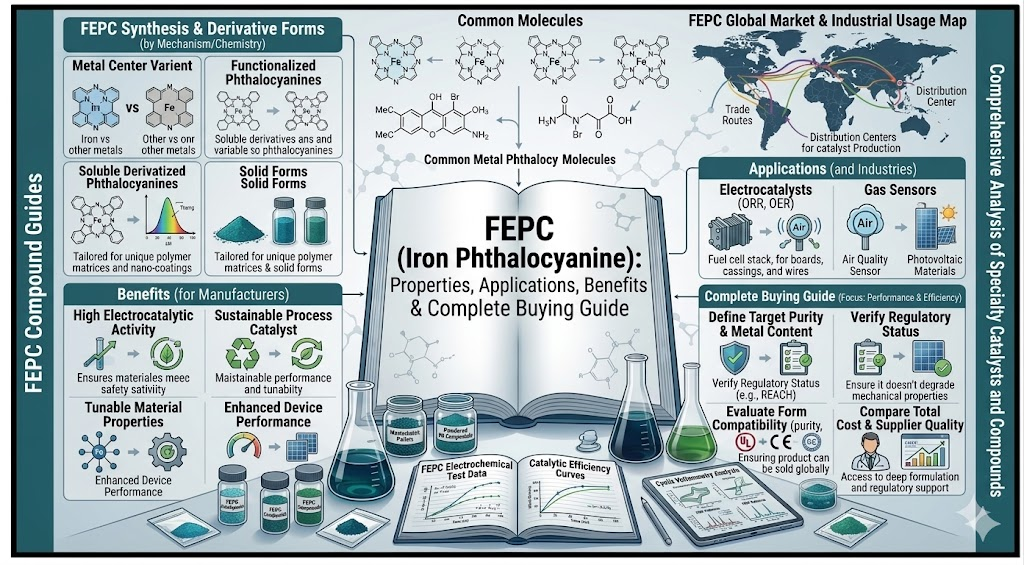
FEPC stands for Iron Phthalocyanine (chemical symbol: FePc). It is a metal phthalocyanine compound in which an iron (Fe) atom sits at the centre of the phthalocyanine (Pc) macrocyclic ring. Its CAS number is 132-16-1 and its molecular formula is C₃₂H₁₆FeN₈, giving it a molecular weight of 568.37 g/mol.
Phthalocyanines are a family of large, planar, aromatic macrocyclic compounds built from four isoindole units linked by nitrogen bridges. When a metal ion is incorporated at the centre of this ring, the resulting metal phthalocyanine acquires unique catalytic, electronic, and optical properties that depend on the specific metal. In the case of FEPC, the iron centre gives the molecule potent oxidation catalysis capability — which is the foundation of its most important industrial application.
In appearance, FEPC is a dark blue powder. It is stable at room temperature, non-volatile, and insoluble in water and most common solvents — typical characteristics of the phthalocyanine family.
Key Properties and Specifications of FEPC
| Property | Details |
| Full Name | Iron Phthalocyanine (Iron(II) Phthalocyanine) |
| Chemical Symbol | FePc (FEPC) |
| CAS Number | 132-16-1 |
| Molecular Formula | C₃₂H₁₆FeN₈ |
| Molecular Weight | 568.37 g/mol |
| EC Number | 205-047-2 |
| Appearance | Dark blue powder |
| Metal Centre | Iron (Fe²⁺) |
| Crystal Structure | β-phase (rod-like morphology) |
| Solubility | Insoluble in water; soluble in concentrated sulphuric acid |
| Thermal Stability | High — stable to >400°C |
| Primary Industrial Function | Rubber peptizing agent (oxidation catalyst) |
| Purity (Industrial Grade) | ≥90% dye content (typical) |
How FEPC Works as a Rubber Peptizing Agent
This is the core industrial application of FEPC, and it is worth understanding the chemistry behind it.
Natural rubber, as it arrives at a rubber goods factory, has very high molecular weight polymer chains. Before it can be compounded with vulcanising agents, fillers, antioxidants, and other additives, its molecular weight needs to be reduced — a process called peptization or mastication. Traditionally, this was done purely by mechanical shearing on a two-roll mill or in an internal mixer (such as a Banbury mixer). The intense mechanical forces physically break the long polymer chains.
FEPC dramatically accelerates this process by acting as a chemical peptizer. During mastication, the mechanical shearing generates free radicals on the rubber chain. In the presence of FEPC and oxygen, the iron centre catalyses the oxidative chain scission reaction — essentially using atmospheric oxygen to chemically cut the chains at the radical sites. This means the rubber breaks down faster, more uniformly, and with significantly less energy input.
The practical benefits are substantial: reduced mastication time (often by 30–50%), lower energy consumption, reduced equipment wear, more consistent Mooney viscosity in the output, and better dispersion of downstream compounding ingredients. For a tyre manufacturer processing thousands of tonnes of rubber per month, even a modest efficiency improvement translates to significant cost savings.
Applications of FEPC Across Industries
1. Rubber Peptizing (Primary Application)
This is where the vast majority of industrially produced FEPC is consumed. Tyre companies, conveyor belt manufacturers, rubber hose producers, and makers of industrial rubber goods all use FEPC to reduce the time and energy required for rubber mastication.
2. Catalysis
FEPC’s iron centre makes it an effective catalyst for several organic reactions, including the oxidation of terminal olefins to methyl ketones, allylic oxidation of cyclic olefins, 1,4-oxidation of 1,3-dienes, and certain elimination reactions. It is used in both academic research and speciality chemical synthesis.
3. Organic Electronics and Photovoltaics
FEPC has been investigated extensively as an organic semiconductor material. Its planar macrocyclic structure and tuneable electronic properties make it a candidate for applications in organic light-emitting diodes (OLEDs), organic thin-film transistors (OTFTs), and organic photovoltaic cells.
4. Electrocatalysis
Recent research has shown FEPC to be a promising non-precious-metal catalyst for the oxygen reduction reaction (ORR) in fuel cells. This is an active area of academic and industrial R&D aimed at replacing expensive platinum-based catalysts.
5. Pigment and Dye Intermediate
While FEPC itself is not widely used as a pigment (unlike copper phthalocyanine, CuPc), it serves as an intermediate in the synthesis of certain speciality dyes and composite green pigments.
FEPC vs. Other Metal Phthalocyanines
The phthalocyanine ring can accommodate many different metal centres, each giving distinct properties. Here is how FEPC compares with the two other commercially important metal phthalocyanines:
| Parameter | FEPC (Iron Phthalocyanine) | CuPc (Copper Phthalocyanine) | ZnPc (Zinc Phthalocyanine) |
| CAS Number | 132-16-1 | 147-14-8 | 14320-04-8 |
| Metal Centre | Iron (Fe) | Copper (Cu) | Zinc (Zn) |
| Appearance | Dark blue powder | Bright blue/green powder | Blue powder |
| Primary Use | Rubber peptizing agent | Pigment (CI Pigment Blue 15) | Oxidation catalyst, inks, colour filters |
| Catalytic Activity | High (oxidation catalyst) | Low | Moderate |
| Pigment Value | Low (not commercially used as pigment) | Very high (dominant blue/green pigment) | Moderate |
| Organic Electronics | Active research area | Active research area | Active research area (photodynamic therapy) |
| Global Production Volume | Moderate | Very high (~57,000+ tonnes/yr for all CuPc) | Lower |
The key distinction: FEPC’s value lies in its catalytic activity (rubber peptizing, electrocatalysis), while CuPc’s value lies in its colour (pigment). ZnPc sits between the two, with moderate catalytic activity and some pigment/ink applications.
Case Study: How a Tyre Manufacturer Reduced Mastication Time by 40% with FEPC
Background: A mid-size tyre manufacturer in Gujarat, India, was processing approximately 200 tonnes per month of natural rubber through Banbury internal mixers. The mastication cycle for achieving the target Mooney viscosity (ML 1+4 at 100°C = 55–65) was taking an average of 12–14 minutes per batch, representing a significant bottleneck in the production line.
The Problem: The long mastication cycles were causing high energy consumption (the Banbury mixer is one of the most energy-intensive machines in a rubber plant), excessive heat build-up in the rubber (risking pre-vulcanisation), and limited daily batch throughput. The company needed to increase output by 25% without investing in a new mixer — a capital expenditure they could not justify.
The Solution: The rubber technologist introduced FEPC (iron phthalocyanine) as a chemical peptizer at a dosage of 0.1–0.2 phr (parts per hundred rubber) during the initial mastication stage. The FEPC was added as a powder directly to the Banbury mixer along with the raw rubber at the beginning of the cycle.
Results:
| Metric | Before (No Peptizer) | After (FEPC at 0.15 phr) |
| Average Mastication Time | 12–14 minutes | 7–8 minutes (∼40% reduction) |
| Target Mooney Viscosity Achieved | Yes (12–14 min) | Yes (7–8 min) |
| Energy Consumption per Batch | Baseline | ~35% reduction |
| Batch Temperature at Dump | 145–155°C | 120–130°C (safer margin) |
| Daily Batch Throughput | 32 batches/day | 44 batches/day (+37.5%) |
| Downstream Filler Dispersion | Acceptable | Improved (lower viscosity base) |
| FEPC Cost per Tonne of Rubber | N/A | ~₹120–180/tonne |
| Capital Investment Required | New mixer (₹2–3 Cr) | Zero (existing equipment) |
Key Takeaway: A chemical additive costing ₹120–180 per tonne of rubber delivered the same throughput increase that would have required a ₹2–3 crore capital investment in a new Banbury mixer. FEPC did not just save energy — it fundamentally changed the economics of the mastication operation. The lower dump temperature also reduced the risk of scorching and improved the quality of downstream compound mixing.
Factors to Consider Before Buying FEPC
Purity and dye content: Industrial-grade FEPC typically has ≥90% dye content. Higher purity ensures more consistent and predictable peptizing performance. Ask for certificates of analysis.
Particle size: Finer particle size ensures better dispersion in the rubber matrix during mastication. Coarse particles may not distribute evenly, leading to inconsistent peptization.
Moisture content: Low moisture is important for consistent dosing and to avoid processing issues. Specifications should clearly state maximum moisture levels.
Manufacturing expertise: Metal phthalocyanine synthesis is a specialised process. Choose a manufacturer with proven experience in this specific chemistry, not a general chemical trader.
ISO certification: ISO 9001:2015, ISO 14001:2015, and ISO 45001:2018 certifications indicate quality, environmental, and safety management.
Technical support: A good FEPC supplier should be able to advise on optimal dosage, addition point (mastication stage), and compatibility with your specific rubber formulation.
Sourcing FEPC: Anar Chemicals
Anar Chemicals LLP is a specialised manufacturer of Metal Phthalocyanines with over 30 years of experience in this product category. They were the first in India to develop speciality metal phthalocyanines and their derivatives for niche applications. Their FEPC (iron phthalocyanine) is manufactured for rubber industry applications and is backed by ISO 9001:2015, ISO 14001:2015 & ISO 45001:2018 certification. They also produce NiPc (nickel phthalocyanine) for reactive dye applications and ZnPc (zinc phthalocyanine) for catalysis and ink applications. Explore their Products page or contact them directly for technical enquiries and bulk pricing.
Frequently Asked Questions About FEPC
Q: What is the full form of FEPC?
FEPC stands for Iron Phthalocyanine, derived from its chemical symbol FePc (Fe for iron, Pc for phthalocyanine). It is a metal phthalocyanine compound with the CAS number 132-16-1 and the molecular formula C₃₂H₁₆FeN₈. In industry, FEPC is most widely known as a rubber peptizing agent.
Q: What is FEPC used for?
FEPC is primarily used as a rubber peptizing agent — a chemical that breaks down the molecular weight of natural rubber and synthetic butadiene-styrene (SBR) rubbers during the mastication process. This makes the rubber softer, more processable, and easier to compound with other ingredients before vulcanisation. FEPC is also used in catalysis, organic electronics research, and as a precursor for certain pigments.
Q: Is FEPC safe to use?
FEPC is considered safe for industrial use when handled with standard chemical safety precautions. It is a stable, non-volatile solid at room temperature. Standard PPE (gloves, eye protection, dust mask) should be used during handling. Always refer to the manufacturer’s Safety Data Sheet (SDS) for specific handling, storage, and disposal guidelines.
Q: How does FEPC work as a rubber peptizer?
FEPC acts as an oxidation catalyst during the mechanical mastication (milling) of rubber. It accelerates the oxidative chain scission of rubber polymer molecules, reducing their molecular weight more quickly and efficiently than mechanical shearing alone. This reduces the time and energy required for mastication, improves processing consistency, and allows better incorporation of compounding ingredients.
Q: What industries use FEPC?
The primary industry for FEPC is the rubber manufacturing sector, including tyre production, rubber goods, and industrial rubber products. FEPC is also used in the dye and pigment industry (as a phthalocyanine intermediate), in catalysis research, in organic electronics (OLED, OTFT), and in photovoltaic cell development.
Q: What is the difference between FEPC and CuPc?
FEPC (iron phthalocyanine) and CuPc (copper phthalocyanine) share the same phthalocyanine ring structure but contain different metal centres. CuPc is primarily used as a blue-green pigment (CI Pigment Blue 15) in inks, paints, and plastics. FEPC is primarily used as a rubber peptizing agent and an oxidation catalyst, not as a pigment, because its colour properties are less commercially useful.
Q: Where can I buy FEPC in India?
Anar Chemicals LLP (anarchem.com) is a specialised manufacturer of metal phthalocyanines with over 30 years of experience in this product category. They produce FEPC (iron phthalocyanine) for rubber industry applications and are ISO 9001:2015, ISO 14001:2015 & ISO 45001:2018 certified. They were the first in India to develop speciality metal phthalocyanines and their derivatives for niche applications.