
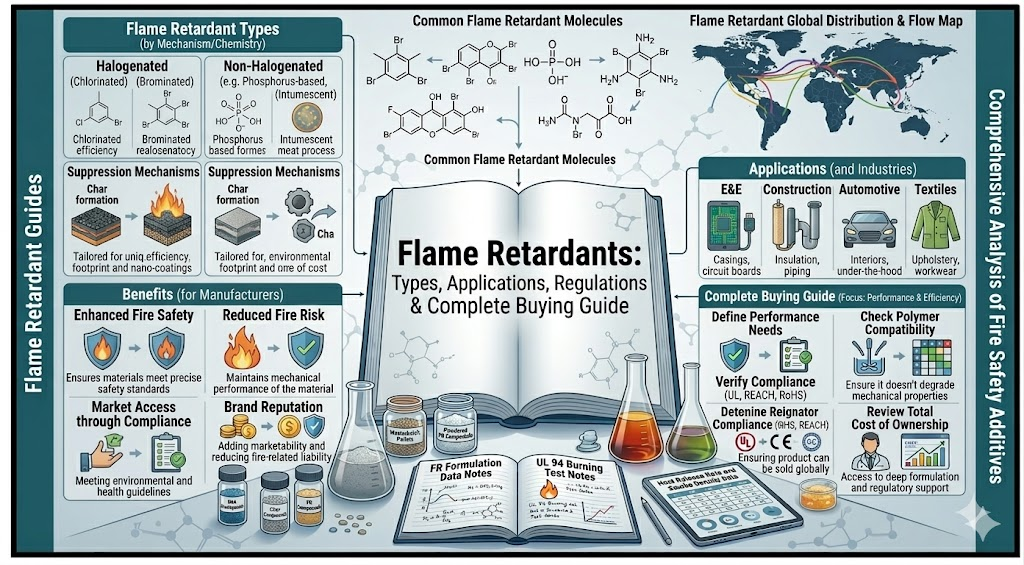
Every plastic component in your car dashboard, every metre of cable in your office building, every foam cushion in your sofa, and every piece of protective workwear on a factory floor has one thing in common: Flame Retardants. These are the chemical compounds that stand between ordinary combustible materials and catastrophic fire — and their importance to public safety is difficult to overstate.
In this guide, we will walk through what Flame Retardants are, how they work, the different types available, where they are used, and the critical regulatory shift that is reshaping the entire industry. Whether you are a polymer engineer, a product compliance manager, or a procurement specialist sourcing fire-safety additives, this article gives you the practical knowledge you need.
What Are Flame Retardants?
Flame Retardants are chemical compounds that are added to or incorporated into materials — primarily plastics, textiles, foams, and coatings — to reduce their flammability and slow the spread of fire. They do not make materials fireproof; rather, they delay ignition, reduce flame spread rate, and give occupants more time to escape in the event of a fire.
Flame Retardants work through one or more of four fundamental mechanisms:
Gas-phase radical trapping: The FR releases active species (phosphorus or halogen radicals) that interrupt the combustion chain reaction by capturing the highly reactive H· and OH· radicals that sustain the flame.
Condensed-phase char formation: The FR promotes the formation of a carbonaceous char layer on the material surface, which acts as a physical barrier between the flame and the unburned material.
Endothermic cooling: Some FRs (like metal hydroxides) decompose endothermically, absorbing heat and releasing water vapour that cools the combustion zone and dilutes flammable gases.
Intumescence: The FR system causes the material to foam up and form an expanded, insulating char that shields the substrate from heat and flame. This is the mechanism used by advanced phosphorus-nitrogen systems like PPM Triazine.
Types of Flame Retardants
Flame Retardants span several chemical families. Here is a comprehensive overview:
| Type | Chemistry | Mechanism | Advantages | Limitations |
| Brominated FRs | Brominated diphenyl ethers, TBBPA | Gas-phase radical trapping | Effective at low loading; good mechanical retention | Toxic smoke; environmental persistence; regulatory phase-out |
| Chlorinated FRs | Chlorinated paraffins, Dechlorane Plus | Gas-phase radical trapping | Low cost; effective in certain polymers | Toxic smoke; restricted under Stockholm Convention |
| Phosphorus-Based FRs | Organophosphates, APP, red phosphorus | Gas-phase + condensed-phase | Halogen-free; good char formation; moderate loading | May affect processing; moisture sensitivity (some types) |
| Phosphorus-Nitrogen (P-N) Systems | APP + triazine synergists | Intumescence (char + gas) | Halogen-free; low smoke; excellent char; versatile | Higher loading than halogenated; requires optimisation |
| Metal Hydroxides | ATH, MDH | Endothermic; water release | Very low toxicity; smoke suppression; low cost | Very high loading (50–65%); severe mechanical impact |
| Nitrogen-Only FRs | Melamine, melamine cyanurate | Gas dilution; endothermic | Halogen-free; good for polyamides | Limited efficacy alone; sublimation at high temps |
| Silicon-Based FRs | Silicones, PDMS, silica | Char reinforcement; barrier | Low toxicity; smoke reduction | Moderate efficacy alone; often used as synergist |
| Intumescent Coatings | P-N-C systems in paint/mastic | Surface char expansion | Protects structural steel; easy retrofit | Application-specific; not suitable for moulded parts |
The Halogenated vs. Halogen-Free Debate
This is the defining conversation in the Flame Retardants industry today. For decades, brominated and chlorinated FRs dominated because of their high efficiency at low loading levels. But the evidence of their environmental and health impacts has driven a global regulatory response:
EU RoHS Directive: Restricts specific brominated FRs (PBBs, PBDEs) in electrical and electronic equipment.
EU REACH: Several halogenated FRs are listed as Substances of Very High Concern (SVHC) or restricted under Annex XVII.
Stockholm Convention: Lists certain brominated FRs as persistent organic pollutants (POPs), requiring elimination or restriction.
OEM mandates: Major automotive, electronics, and appliance manufacturers (Apple, Samsung, BMW, Volvo) now require halogen-free materials in their supply chain specifications.
| Factor | Halogenated Flame Retardants | Halogen-Free Flame Retardants |
| Efficacy at Low Loading | Excellent (10–20%) | Good to excellent (20–35% depending on system) |
| Smoke Toxicity | High (HBr, HCl, dioxins, furans) | Low (minimal toxic gases) |
| Regulatory Status | Increasingly restricted | Fully compliant; growing mandate |
| Environmental Persistence | High (some are POPs) | Low |
| Recyclability | Problematic (toxic gases in thermal recycling) | Compatible with recycling |
| Mechanical Impact | Low (due to lower loading) | Moderate (higher loading in some systems) |
| Industry Trend | Declining | Rapidly growing |
| Cost | Lower (but rising with restrictions) | Moderate to high |
The trend is unmistakable: halogen-free Flame Retardants are becoming the industry standard. The question for most manufacturers is not whether to switch, but which halogen-free system to adopt.
Key Applications of Flame Retardants
Electronics and Electrical
PCB laminates, cable insulation, connectors, battery housings, smartphone and laptop enclosures. RoHS compliance has driven near-universal adoption of halogen-free FRs in consumer electronics. With the growth of EVs, battery pack fire safety is creating enormous new demand.
Construction and Building
Insulation boards (EPS, XPS, PU), cladding panels, roofing membranes, pipe insulation, structural steel coatings, and cable trays. Building fire codes (Euroclass, ASTM E84, BS 476) mandate specific flame performance levels.
Automotive and Transport
Dashboard components, seat foams, headliners, under-hood parts, wire harnesses, and EV battery enclosures. FMVSS 302 in the US and ECE R118 in Europe set the baseline. OEM specs often exceed regulatory minimums.
Textiles and Furnishings
Protective workwear, military uniforms, aircraft seating, hotel curtains, mattress ticking, and upholstery. Standards like EN 11612 (protective clothing), BS 5852 (furniture), and FAR 25.853 (aircraft interiors) drive FR use.
Railway and Aerospace
Interior panels, flooring, cable ducting, and seat materials. EN 45545 (railway fire safety) and FAR 25.853 impose some of the most demanding flame, smoke, and toxicity (FST) requirements in any industry.
PPM Triazine: A Next-Generation Halogen-Free Flame Retardant
Among the halogen-free options available, PPM Triazine (CAS 93058-67-4) represents a technically advanced phosphorus-nitrogen intumescent system developed by MCA Technologies, Switzerland. It is a polymeric nitrogen synergist designed to work with ammonium polyphosphate (APP) to create a highly effective intumescent FR system.
What sets PPM Triazine apart from conventional nitrogen synergists (such as melamine or simple triazine derivatives) is its large molecular weight. This polymeric structure eliminates three persistent problems that plague smaller-molecule alternatives: sublimation during high-temperature processing, toxic ammonia liberation from self-condensation, and mould deposits or plate-out on finished parts.
| Property | PPM Triazine HF Details |
| Trade Name | MCA PPM Triazine HF |
| CAS Number | 93058-67-4 |
| Chemistry | Proprietary polymeric triazine (P-N synergist) |
| Recommended Blend | 75% APP + 25% PPM Triazine HF |
| Typical Loading | 20–25% in polymer |
| UL 94 Performance | V0 at 1.6mm (in PP) |
| LOI Achievement | >30% |
| Smoke Density | Low |
| Polymer Compatibility | PP, PU foams (rigid & flexible), epoxy, unsaturated polyester, TPE |
| Processing Advantage | No sublimation, no ammonia release, no mould deposits |
Case Study: Automotive Interior Manufacturer Transitions to Halogen-Free Flame Retardants
Background: A Tier-1 automotive supplier manufacturing polypropylene interior trim components for a major European OEM received a supply chain directive: all plastic components must transition from brominated FR systems to halogen-free alternatives within 18 months, to comply with the OEM’s updated material specification and anticipated EU regulatory changes.
The Problem: The existing brominated FR system achieved UL 94 V0 at just 12% loading with excellent mechanical property retention. Initial trials with aluminium trihydroxide (ATH) required 55% loading to approach V0, which reduced impact strength by 60% and made the parts too brittle for crash safety requirements. A melamine-based nitrogen system caused processing problems: ammonia odour, surface deposits, and mould fouling.
The Solution: The engineering team adopted an intumescent system using 75% ammonium polyphosphate + 25% PPM Triazine HF at 23% total loading. The polymeric structure of PPM Triazine eliminated the sublimation and ammonia issues encountered with smaller-molecule alternatives.
Results:
| Metric | Brominated FR (Baseline) | ATH System (Trial) | PPM Triazine System (Final) |
| UL 94 Rating | V0 | V2 (borderline) | V0 |
| FR Loading Level | 12% | 55% | 23% |
| Impact Strength (% of neat PP) | 92% | 40% | 82% |
| Smoke Density | High | Moderate | Low |
| Processing Issues | None | None | None |
| Mould Deposits | None | None | None |
| Regulatory Compliance | Failing (halogenated) | Passing (halogen-free) | Passing (halogen-free) |
| OEM Approval | Withdrawn | Failed (mechanical) | Approved |
Key Takeaway: PPM Triazine delivered halogen-free V0 performance at less than half the loading required by ATH, preserving the mechanical integrity critical for automotive crash safety. The total cost increase was approximately 8–10% on the FR additive line item, but this was offset by maintaining the existing moulding cycle time (no retooling) and avoiding the mechanical failures that would have required part redesign.
Factors to Consider Before Buying Flame Retardants
Target regulation: Identify the fire safety standard your product must meet (UL 94, LOI, EN 45545, FAR 25.853, etc.) and work backwards to the FR system that achieves it.
Halogen-free requirement: If your customer or end-market mandates halogen-free, this immediately narrows your options to phosphorus, nitrogen, metal hydroxide, or silicon-based systems.
Mechanical property impact: Higher FR loading degrades mechanical properties. Choose systems that achieve the required fire rating at the lowest possible loading to preserve impact strength, tensile strength, and elongation.
Processing compatibility: The FR must be compatible with your polymer’s processing temperature, shear conditions, and moulding/extrusion parameters without causing degradation, discolouration, or equipment fouling.
Smoke and toxicity: For enclosed-space applications (railway, aerospace, electronics), smoke density and toxic gas emission may be as important as flame resistance itself.
Supplier expertise: Choose a supplier that provides not just the FR additive but also formulation guidance, technical support, and regulatory know-how.
Sourcing Flame Retardants: PPM Triazine from Anar Chemicals
Anar Chemicals LLP is the exclusive licensee of MCA Technologies, Switzerland, for manufacturing and marketing PPM Triazine in India. The product is marketed through Anar Mcat Advanced Electronic Chemicals Pvt. Ltd., a joint venture between Anar Chemicals LLP and MCA Technologies GmbH. With over four decades of chemical manufacturing experience and triple ISO certification (9001, 14001, 45001), Anar Chemicals provides both the product and the technical support needed to successfully formulate halogen-free flame retardant systems. Explore the PPM Triazine product page or contact them for technical enquiries and bulk pricing.
Frequently Asked Questions About Flame Retardants
Q: What are Flame Retardants?
Flame Retardants are chemical compounds added to materials — plastics, textiles, foams, coatings, and construction products — to inhibit or slow the spread of fire. They work by interfering with the combustion process through gas-phase radical trapping, condensed-phase char formation, endothermic cooling, or a combination of these mechanisms.
Q: What is the difference between halogenated and halogen-free Flame Retardants?
Halogenated Flame Retardants use bromine or chlorine compounds to trap combustion radicals in the gas phase. They are effective at low loading levels but release toxic smoke, corrosive gases, and environmental pollutants during combustion. Halogen-free Flame Retardants use phosphorus, nitrogen, metal hydroxides, or silicon-based chemistry to achieve flame resistance with dramatically lower smoke toxicity and environmental impact.
Q: Why is the industry shifting to halogen-free Flame Retardants?
The shift is driven by stricter environmental regulations (EU RoHS, REACH, WEEE), growing concern over toxic smoke in building and vehicle fires, persistence of halogenated compounds in ecosystems, and OEM mandates requiring halogen-free materials across supply chains. The trend is accelerating, particularly in electronics, automotive, and construction sectors.
Q: What is PPM Triazine and how does it work?
PPM Triazine (CAS 93058-67-4) is a proprietary polymeric nitrogen synergist from MCA Technologies, Switzerland. When blended with ammonium polyphosphate (APP), it creates an intumescent flame retardant system: upon exposure to heat, the material foams, cross-links, and forms a dense protective char that acts as a fire shield — blocking heat, reducing oxygen, and preventing polymer dripping.
Q: What UL 94 ratings can be achieved with Flame Retardants?
Ratings depend on the FR system and loading level. With PPM Triazine + APP at 20–25% loading, UL 94 V0 is achievable in polypropylene at 1.6mm. Metal hydroxide systems may require 50–60% loading for equivalent ratings, which can degrade mechanical properties. Halogenated systems typically achieve V0 at 10–20% loading.
Q: Which industries use Flame Retardants most?
The largest consumers are electronics (PCBs, cables, housings), construction (insulation, cladding, structural coatings), automotive (interior components, EV battery packs, wire harnesses), textiles (protective workwear, upholstery), and railway/aerospace (interior panels, seating). Every sector where fire safety standards apply uses Flame Retardants.
Q: Where can I buy halogen-free Flame Retardants in India?
Anar Chemicals LLP (anarchem.com) is the exclusive licensee of MCA Technologies, Switzerland, for manufacturing and marketing PPM Triazine — an advanced halogen-free flame retardant based on phosphorus-nitrogen chemistry. They are ISO 9001:2015, ISO 14001:2015 & ISO 45001:2018 certified with over 40 years of experience.