
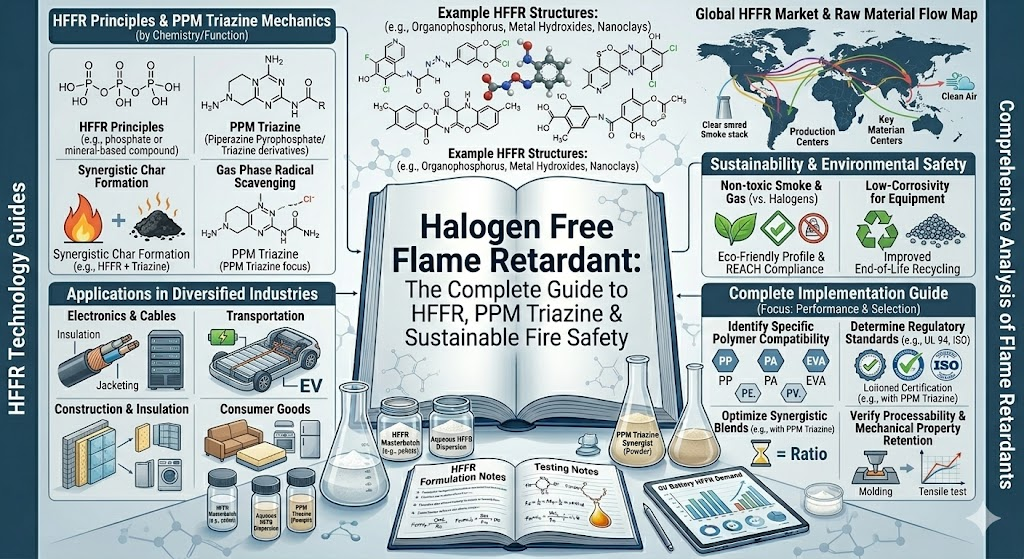
If you work in plastics engineering, automotive component design, electronics manufacturing, or textile development, you have almost certainly felt the regulatory pressure building around flame retardants over the past decade. The message from the market is clear: halogenated flame retardants are being phased out, and Halogen Free Flame Retardant (HFFR) solutions are the future.
But making the switch is not as simple as swapping one additive for another. You need to understand the chemistry, the performance trade-offs, the regulatory landscape, and the specific products available. In this guide, we will cover all of that — with a particular focus on PPM Triazine, a phosphorus-nitrogen based HFFR that represents the state of the art in intumescent flame retardation.
What Is a Halogen Free Flame Retardant?
A Halogen Free Flame Retardant is a fire-safety additive that achieves flame resistance without using any halogen elements — chlorine, bromine, fluorine, or iodine. Traditional halogenated flame retardants (such as brominated diphenyl ethers and chlorinated paraffins) are highly effective at preventing ignition, but they come with serious drawbacks: during combustion, they release dense, toxic smoke containing hydrogen halide gases, dioxins, and furans that are harmful to both human health and the environment.
Halogen-free alternatives use different chemistries to achieve flame resistance. The most commercially successful approach is phosphorus-nitrogen (P-N) synergism, which works through intumescence: when exposed to heat or flame, the material foams up and forms a dense, insulating char layer on the surface. This char acts as a fire shield, blocking heat transfer, reducing oxygen access, and preventing molten polymer from dripping.
The result is effective flame retardation with dramatically reduced toxic smoke, no halogenated by-products, and compatibility with modern environmental regulations like RoHS, REACH, and WEEE.
Why the Industry Is Moving to Halogen Free
Regulatory pressure: The EU’s RoHS Directive restricts certain halogenated compounds in electronics. REACH requires registration and risk assessment of chemical substances, with several halogenated FRs already on the Candidate List of Substances of Very High Concern (SVHC). Many OEMs now mandate halogen-free materials across their supply chains.
Toxic smoke concerns: In building fires, smoke inhalation is the leading cause of death — and halogenated flame retardants contribute significantly to smoke toxicity. HFFR systems produce far less toxic, less corrosive smoke, improving survivability in enclosed spaces.
Environmental persistence: Some halogenated FRs are persistent organic pollutants that bioaccumulate in ecosystems. HFFRs avoid this problem entirely.
Recyclability: Halogen-free plastics are easier to recycle. Halogenated materials can release toxic gases during thermal recycling processes, complicating end-of-life management.
Types of Halogen Free Flame Retardants
| Type | Chemistry | Mechanism | Key Applications | Examples |
| Phosphorus-Nitrogen (P-N) Systems | APP + triazine synergists | Intumescence (char formation + gas release) | Engineering plastics, PP, PU foams, textiles | PPM Triazine + APP, melamine polyphosphate |
| Metal Hydroxides | ATH, MDH | Endothermic decomposition, water release | Cables, wire insulation, construction | Aluminium trihydroxide, magnesium hydroxide |
| Phosphorus Esters | Organophosphorus | Gas-phase radical trapping + condensed-phase char | PC, PPO, epoxy resins | Resorcinol bis(diphenyl phosphate), BDP |
| Nitrogen-Only Systems | Melamine, guanidine derivatives | Gas dilution, endothermic decomposition | Polyamides, PU | Melamine cyanurate, guanidine phosphate |
| Silicon-Based | Silicones, siloxanes | Char reinforcement, barrier formation | Coatings, textiles, electronics | PDMS additives, silica |
| Intumescent Coatings | P-N-C systems | Surface char expansion on heat exposure | Steel structures, cables, wood | Intumescent paints and mastics |
PPM Triazine: A Closer Look at Advanced P-N Flame Retardation
Among the phosphorus-nitrogen HFFR systems available, PPM Triazine (CAS 93058-67-4) stands out as a technically advanced solution. Developed by MCA Technologies of Switzerland, PPM Triazine is a proprietary polymeric nitrogen synergist that, when combined with ammonium polyphosphate (APP), creates a highly effective intumescent flame retardant system.
Here is what makes it different from conventional nitrogen synergists (such as melamine or simple triazine derivatives):
Large molecular weight: Unlike small-molecule nitrogen synergists, PPM Triazine’s polymeric structure prevents sublimation during high-temperature processing, eliminates toxic ammonia liberation from self-condensation, and avoids mould deposits and plate-out issues that plague lower-molecular-weight alternatives.
Proven performance: A blend of 75% APP and 25% PPM Triazine HF at 20–25% total loading typically achieves UL 94 V0 at 1.6mm in polypropylene, with LOI values exceeding 30%.
Versatility: The system works across polypropylene, polyurethane rigid and flexible foams, epoxy resins, unsaturated polyester resins, and thermoplastic elastomers.
Low smoke, low toxicity: The intumescent char formation produces minimal smoke density and significantly fewer toxic fumes compared to both halogenated systems and some competing HFFR technologies.
Key Properties of PPM Triazine HF
| Property | Details |
| Trade Name | MCA PPM Triazine HF |
| CAS Number | 93058-67-4 |
| Chemistry | Proprietary polymeric triazine (phosphorus-nitrogen synergist) |
| Physical Form | Fine powder |
| Function | Nitrogen synergist for intumescent flame retardation |
| Recommended Blend | 75% APP + 25% PPM Triazine HF |
| Typical Loading | 20–25% in polymer |
| Performance | UL 94 V0 at 1.6mm (PP); LOI >30% |
| Smoke Density | Low |
| Toxic Fumes | Significantly reduced vs. halogenated FRs |
| Processing Advantage | No sublimation, no ammonia release, no mould deposits |
| Polymer Compatibility | PP, PU foams, epoxy, unsaturated polyester, TPE |
Halogen Free vs. Halogenated Flame Retardants: A Direct Comparison
| Factor | Halogen Free Flame Retardant | Halogenated Flame Retardant |
| Chemistry | Phosphorus, nitrogen, metal hydroxides, silicon | Bromine, chlorine compounds |
| Smoke Toxicity | Low — minimal toxic gases | High — HBr, HCl, dioxins, furans |
| Smoke Density | Low to moderate | Often high |
| Environmental Persistence | Low — no persistent organic pollutants | High — some are POPs |
| Regulatory Status | Fully compliant (RoHS, REACH, WEEE) | Increasing restrictions and phase-outs |
| Recyclability | Compatible with thermal recycling | May release toxic gases during recycling |
| Typical Loading Level | 20–35% (varies by system) | 10–25% (generally lower) |
| Cost | Moderate to high | Lower (but rising with regulation) |
| Mechanical Impact | Moderate (higher loading can affect properties) | Lower loading, less mechanical impact |
| Industry Trend | Growing rapidly — becoming standard | Declining — being phased out |
Applications of Halogen Free Flame Retardants
Electronics and Electrical
PCB laminates, cable insulation, connectors, housings, and enclosures. RoHS compliance is driving near-universal adoption of HFFR in consumer electronics.
Automotive
Interior trim, dashboard components, under-hood parts, battery housings (especially critical for EV battery packs), and wire harnesses. OEMs increasingly specify halogen-free materials.
Construction and Building
Insulation boards, cladding panels, pipe insulation, and structural coatings. Building codes in Europe and Asia are increasingly mandating low-smoke, halogen-free materials.
Railway and Aerospace
Interior panels, seat upholstery, cable ducting, and flooring. EN 45545 (railway) and FAR 25.853 (aerospace) standards drive HFFR adoption in these sectors.
Textiles
Protective workwear, upholstery, curtains, and mattress ticking. Phosphorus-nitrogen HFFR treatments can achieve self-extinguishing performance with durability through multiple wash cycles.
Case Study: Achieving UL 94 V0 in a Polypropylene Automotive Component with PPM Triazine
Background: A Tier-1 automotive component manufacturer supplying interior trim parts to a European OEM was required to transition all polypropylene (PP) components from a brominated flame retardant system to a halogen-free alternative to meet the OEM’s updated material specification. The target was UL 94 V0 at 1.6mm with no dripping, plus compliance with the OEM’s internal low-smoke requirements.
The Problem: Initial trials with metal hydroxide (ATH) based HFFR systems required loading levels above 55% to approach V0 performance, which severely degraded the mechanical properties of the PP compound — impact strength dropped by 60%, and the parts became too brittle to pass the OEM’s crash safety tests. A melamine polyphosphate system was also tested but failed due to ammonia odour during processing and surface deposits on moulded parts.
The Solution: The manufacturer switched to an intumescent system using 75% ammonium polyphosphate (APP) + 25% PPM Triazine HF at a total loading of 23%. The PPM Triazine’s polymeric structure eliminated the sublimation and ammonia issues encountered with smaller-molecule nitrogen synergists.
Results:
| Metric | ATH System (55% loading) | PPM Triazine System (23% loading) |
| UL 94 Rating | V2 (borderline) | V0 (achieved at 1.6mm) |
| LOI | 24% | 32% |
| Total FR Loading | 55% | 23% |
| Notched Izod Impact Strength | 40% of neat PP | 82% of neat PP |
| Processing Odour | None | None (no ammonia) |
| Mould Deposits | None | None (no sublimation) |
| Smoke Density (NBS) | Moderate | Low |
| OEM Approval | Failed (mechanical) | Passed all criteria |
Key Takeaway: The PPM Triazine-based intumescent system achieved superior flame retardant performance at less than half the loading level of ATH, preserving the mechanical integrity that the automotive application demanded. This case illustrates why phosphorus-nitrogen intumescent systems are becoming the HFFR technology of choice for engineering plastics.
Sourcing Halogen Free Flame Retardants: PPM Triazine from Anar Chemicals
Anar Chemicals LLP is the exclusive licensee of MCA Technologies, Switzerland, for manufacturing and marketing PPM Triazine in India. The product is marketed through Anar Mcat Advanced Electronic Chemicals Pvt. Ltd., a joint venture between Anar Chemicals and MCA Technologies GmbH. With over four decades of chemical manufacturing experience and ISO 9001:2015, ISO 14001:2015 & ISO 45001:2018 certification, Anar Chemicals offers technical support for formulation development alongside reliable, quality-assured supply. Explore the PPM Triazine product page or contact them directly for technical enquiries and bulk pricing.
Frequently Asked Questions About Halogen Free Flame Retardant
Q: What is a Halogen Free Flame Retardant?
A Halogen Free Flame Retardant (HFFR) is a fire-safety additive that does not contain chlorine, bromine, fluorine, or iodine. Instead, it uses alternative chemistries — most commonly phosphorus-nitrogen synergism — to achieve flame resistance. HFFRs produce significantly less toxic smoke and corrosive gases during combustion compared to halogenated alternatives.
Q: What is PPM Triazine?
PPM Triazine (CAS 93058-67-4) is a proprietary polymeric, halogen-free nitrogen synergist developed by MCA Technologies, Switzerland. It works through intumescent flame retardation in combination with ammonium polyphosphate (APP). When exposed to fire, the system foams, cross-links, and forms a solid protective char layer that acts as a fire shield.
Q: How does phosphorus-nitrogen synergism work in flame retardants?
Phosphorus compounds release phosphoric acid during combustion, which catalyses char formation on the material surface. Nitrogen compounds release inert gases that dilute flammable gases and create a protective foam (intumescence). Together, they form a dense, insulating char layer that blocks heat transfer, reduces oxygen permeability, and prevents molten polymer dripping.
Q: What are the advantages of HFFR over halogenated flame retardants?
HFFRs produce dramatically less toxic smoke and fewer corrosive gases during fire, improving survivability in enclosed spaces. They do not release dioxins or furans, meet increasingly strict environmental regulations (RoHS, REACH, WEEE), and are compatible with recycling processes. Their main trade-off is that higher loading levels may be required compared to some halogenated systems.
Q: What UL 94 ratings can be achieved with PPM Triazine?
A blend of 75% ammonium polyphosphate and 25% PPM Triazine HF at 20–25% total loading typically achieves UL 94 V0 rating in polypropylene at 1.6mm thickness, along with LOI values above 30%. Similar ratings are achievable in polyurethane foams, epoxy resins, and unsaturated polyester resins.
Q: Which industries require halogen-free flame retardants?
Key industries include electronics and electrical (PCBs, cable insulation, connectors), automotive (interior components, under-hood parts), construction (insulation, cladding), railway and aerospace (interior panels, seating), and textiles (workwear, upholstery, curtains). Regulatory pressure is strongest in the EU, where RoHS and REACH have driven widespread HFFR adoption.
Q: Where can I buy Halogen Free Flame Retardant in India?
Anar Chemicals LLP is the exclusive licensee of MCA Technologies Switzerland for manufacturing and marketing PPM Triazine in India. They operate through a dedicated joint venture, Anar Mcat Advanced Electronic Chemicals Pvt. Ltd., and are ISO 9001:2015, ISO 14001:2015 & ISO 45001:2018 certified.