Uncategorized

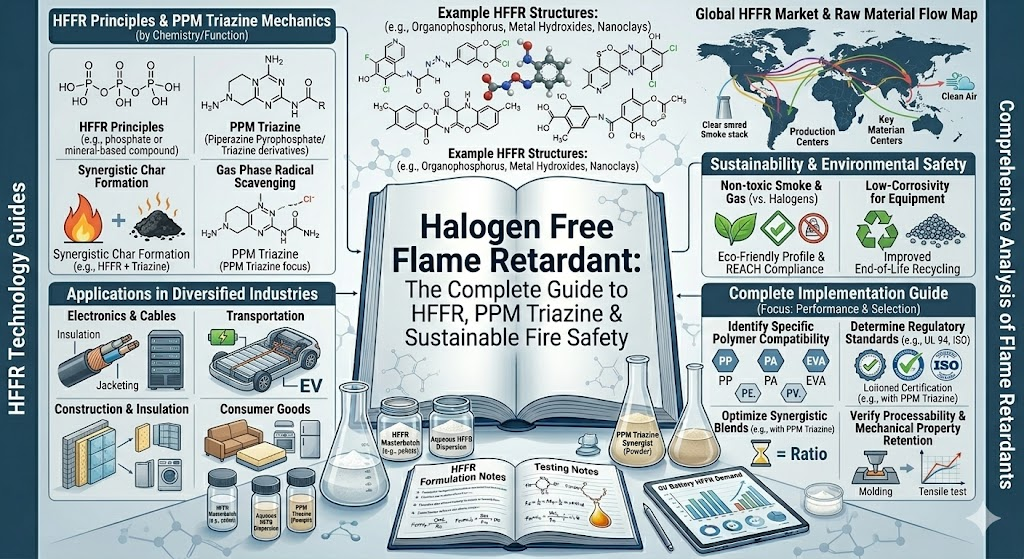
Halogen Free Flame Retardant: The Complete Guide to HFFR, PPM Triazine & Sustainable Fire Safety

If you work in plastics engineering, automotive component design, electronics manufacturing, or textile development, you have almost certainly felt the regulatory pressure building around flame retardants over the past decade. The message from the market is clear: halogenated flame retardants are being phased out, and Halogen Free Flame Retardant (HFFR) solutions are the future.

But making the switch is not as simple as swapping one additive for another. You need to understand the chemistry, the performance trade-offs, the regulatory landscape, and the specific products available. In this guide, we will cover all of that — with a particular focus on PPM Triazine, a phosphorus-nitrogen based HFFR that represents the state of the art in intumescent flame retardation.

What Is a Halogen Free Flame Retardant?

A Halogen Free Flame Retardant is a fire-safety additive that achieves flame resistance without using any halogen elements — chlorine, bromine, fluorine, or iodine. Traditional halogenated flame retardants (such as brominated diphenyl ethers and chlorinated paraffins) are highly effective at preventing ignition, but they come with serious drawbacks: during combustion, they release dense, toxic smoke containing hydrogen halide gases, dioxins, and furans that are harmful to both human health and the environment.

Halogen-free alternatives use different chemistries to achieve flame resistance. The most commercially successful approach is phosphorus-nitrogen (P-N) synergism, which works through intumescence: when exposed to heat or flame, the material foams up and forms a dense, insulating char layer on the surface. This char acts as a fire shield, blocking heat transfer, reducing oxygen access, and preventing molten polymer from dripping.

The result is effective flame retardation with dramatically reduced toxic smoke, no halogenated by-products, and compatibility with modern environmental regulations like RoHS, REACH, and WEEE.

Why the Industry Is Moving to Halogen Free

Regulatory pressure: The EU’s RoHS Directive restricts certain halogenated compounds in electronics. REACH requires registration and risk assessment of chemical substances, with several halogenated FRs already on the Candidate List of Substances of Very High Concern (SVHC). Many OEMs now mandate halogen-free materials across their supply chains.

Toxic smoke concerns: In building fires, smoke inhalation is the leading cause of death — and halogenated flame retardants contribute significantly to smoke toxicity. HFFR systems produce far less toxic, less corrosive smoke, improving survivability in enclosed spaces.

Environmental persistence: Some halogenated FRs are persistent organic pollutants that bioaccumulate in ecosystems. HFFRs avoid this problem entirely.

Recyclability: Halogen-free plastics are easier to recycle. Halogenated materials can release toxic gases during thermal recycling processes, complicating end-of-life management.

Types of Halogen Free Flame Retardants

Type Chemistry Mechanism Key Applications Examples
Phosphorus-Nitrogen (P-N) Systems APP + triazine synergists Intumescence (char formation + gas release) Engineering plastics, PP, PU foams, textiles PPM Triazine + APP, melamine polyphosphate
Metal Hydroxides ATH, MDH Endothermic decomposition, water release Cables, wire insulation, construction Aluminium trihydroxide, magnesium hydroxide
Phosphorus Esters Organophosphorus Gas-phase radical trapping + condensed-phase char PC, PPO, epoxy resins Resorcinol bis(diphenyl phosphate), BDP
Nitrogen-Only Systems Melamine, guanidine derivatives Gas dilution, endothermic decomposition Polyamides, PU Melamine cyanurate, guanidine phosphate
Silicon-Based Silicones, siloxanes Char reinforcement, barrier formation Coatings, textiles, electronics PDMS additives, silica
Intumescent Coatings P-N-C systems Surface char expansion on heat exposure Steel structures, cables, wood Intumescent paints and mastics

PPM Triazine: A Closer Look at Advanced P-N Flame Retardation

Among the phosphorus-nitrogen HFFR systems available, PPM Triazine (CAS 93058-67-4) stands out as a technically advanced solution. Developed by MCA Technologies of Switzerland, PPM Triazine is a proprietary polymeric nitrogen synergist that, when combined with ammonium polyphosphate (APP), creates a highly effective intumescent flame retardant system.

Here is what makes it different from conventional nitrogen synergists (such as melamine or simple triazine derivatives):

Large molecular weight: Unlike small-molecule nitrogen synergists, PPM Triazine’s polymeric structure prevents sublimation during high-temperature processing, eliminates toxic ammonia liberation from self-condensation, and avoids mould deposits and plate-out issues that plague lower-molecular-weight alternatives.

Proven performance: A blend of 75% APP and 25% PPM Triazine HF at 20–25% total loading typically achieves UL 94 V0 at 1.6mm in polypropylene, with LOI values exceeding 30%.

Versatility: The system works across polypropylene, polyurethane rigid and flexible foams, epoxy resins, unsaturated polyester resins, and thermoplastic elastomers.

Low smoke, low toxicity: The intumescent char formation produces minimal smoke density and significantly fewer toxic fumes compared to both halogenated systems and some competing HFFR technologies.

Key Properties of PPM Triazine HF

Property Details
Trade Name MCA PPM Triazine HF
CAS Number 93058-67-4
Chemistry Proprietary polymeric triazine (phosphorus-nitrogen synergist)
Physical Form Fine powder
Function Nitrogen synergist for intumescent flame retardation
Recommended Blend 75% APP + 25% PPM Triazine HF
Typical Loading 20–25% in polymer
Performance UL 94 V0 at 1.6mm (PP); LOI >30%
Smoke Density Low
Toxic Fumes Significantly reduced vs. halogenated FRs
Processing Advantage No sublimation, no ammonia release, no mould deposits
Polymer Compatibility PP, PU foams, epoxy, unsaturated polyester, TPE

Halogen Free vs. Halogenated Flame Retardants: A Direct Comparison

Factor Halogen Free Flame Retardant Halogenated Flame Retardant
Chemistry Phosphorus, nitrogen, metal hydroxides, silicon Bromine, chlorine compounds
Smoke Toxicity Low — minimal toxic gases High — HBr, HCl, dioxins, furans
Smoke Density Low to moderate Often high
Environmental Persistence Low — no persistent organic pollutants High — some are POPs
Regulatory Status Fully compliant (RoHS, REACH, WEEE) Increasing restrictions and phase-outs
Recyclability Compatible with thermal recycling May release toxic gases during recycling
Typical Loading Level 20–35% (varies by system) 10–25% (generally lower)
Cost Moderate to high Lower (but rising with regulation)
Mechanical Impact Moderate (higher loading can affect properties) Lower loading, less mechanical impact
Industry Trend Growing rapidly — becoming standard Declining — being phased out

Applications of Halogen Free Flame Retardants

Electronics and Electrical

PCB laminates, cable insulation, connectors, housings, and enclosures. RoHS compliance is driving near-universal adoption of HFFR in consumer electronics.

Automotive

Interior trim, dashboard components, under-hood parts, battery housings (especially critical for EV battery packs), and wire harnesses. OEMs increasingly specify halogen-free materials.

Construction and Building

Insulation boards, cladding panels, pipe insulation, and structural coatings. Building codes in Europe and Asia are increasingly mandating low-smoke, halogen-free materials.

Railway and Aerospace

Interior panels, seat upholstery, cable ducting, and flooring. EN 45545 (railway) and FAR 25.853 (aerospace) standards drive HFFR adoption in these sectors.

Textiles

Protective workwear, upholstery, curtains, and mattress ticking. Phosphorus-nitrogen HFFR treatments can achieve self-extinguishing performance with durability through multiple wash cycles.

Case Study: Achieving UL 94 V0 in a Polypropylene Automotive Component with PPM Triazine

Background: A Tier-1 automotive component manufacturer supplying interior trim parts to a European OEM was required to transition all polypropylene (PP) components from a brominated flame retardant system to a halogen-free alternative to meet the OEM’s updated material specification. The target was UL 94 V0 at 1.6mm with no dripping, plus compliance with the OEM’s internal low-smoke requirements.

The Problem: Initial trials with metal hydroxide (ATH) based HFFR systems required loading levels above 55% to approach V0 performance, which severely degraded the mechanical properties of the PP compound — impact strength dropped by 60%, and the parts became too brittle to pass the OEM’s crash safety tests. A melamine polyphosphate system was also tested but failed due to ammonia odour during processing and surface deposits on moulded parts.

The Solution: The manufacturer switched to an intumescent system using 75% ammonium polyphosphate (APP) + 25% PPM Triazine HF at a total loading of 23%. The PPM Triazine’s polymeric structure eliminated the sublimation and ammonia issues encountered with smaller-molecule nitrogen synergists.

Results:

Metric ATH System (55% loading) PPM Triazine System (23% loading)
UL 94 Rating V2 (borderline) V0 (achieved at 1.6mm)
LOI 24% 32%
Total FR Loading 55% 23%
Notched Izod Impact Strength 40% of neat PP 82% of neat PP
Processing Odour None None (no ammonia)
Mould Deposits None None (no sublimation)
Smoke Density (NBS) Moderate Low
OEM Approval Failed (mechanical) Passed all criteria

Key Takeaway: The PPM Triazine-based intumescent system achieved superior flame retardant performance at less than half the loading level of ATH, preserving the mechanical integrity that the automotive application demanded. This case illustrates why phosphorus-nitrogen intumescent systems are becoming the HFFR technology of choice for engineering plastics.

Sourcing Halogen Free Flame Retardants: PPM Triazine from Anar Chemicals

Anar Chemicals LLP  is the exclusive licensee of MCA Technologies, Switzerland, for manufacturing and marketing PPM Triazine in India. The product is marketed through Anar Mcat Advanced Electronic Chemicals Pvt. Ltd., a joint venture between Anar Chemicals and MCA Technologies GmbH. With over four decades of chemical manufacturing experience and ISO 9001:2015, ISO 14001:2015 & ISO 45001:2018 certification, Anar Chemicals offers technical support for formulation development alongside reliable, quality-assured supply. Explore the PPM Triazine product page or contact them directly for technical enquiries and bulk pricing.

Frequently Asked Questions About Halogen Free Flame Retardant

Q: What is a Halogen Free Flame Retardant?

A Halogen Free Flame Retardant (HFFR) is a fire-safety additive that does not contain chlorine, bromine, fluorine, or iodine. Instead, it uses alternative chemistries — most commonly phosphorus-nitrogen synergism — to achieve flame resistance. HFFRs produce significantly less toxic smoke and corrosive gases during combustion compared to halogenated alternatives.

Q: What is PPM Triazine?

PPM Triazine (CAS 93058-67-4) is a proprietary polymeric, halogen-free nitrogen synergist developed by MCA Technologies, Switzerland. It works through intumescent flame retardation in combination with ammonium polyphosphate (APP). When exposed to fire, the system foams, cross-links, and forms a solid protective char layer that acts as a fire shield.

Q: How does phosphorus-nitrogen synergism work in flame retardants?

Phosphorus compounds release phosphoric acid during combustion, which catalyses char formation on the material surface. Nitrogen compounds release inert gases that dilute flammable gases and create a protective foam (intumescence). Together, they form a dense, insulating char layer that blocks heat transfer, reduces oxygen permeability, and prevents molten polymer dripping.

Q: What are the advantages of HFFR over halogenated flame retardants?

HFFRs produce dramatically less toxic smoke and fewer corrosive gases during fire, improving survivability in enclosed spaces. They do not release dioxins or furans, meet increasingly strict environmental regulations (RoHS, REACH, WEEE), and are compatible with recycling processes. Their main trade-off is that higher loading levels may be required compared to some halogenated systems.

Q: What UL 94 ratings can be achieved with PPM Triazine?

A blend of 75% ammonium polyphosphate and 25% PPM Triazine HF at 20–25% total loading typically achieves UL 94 V0 rating in polypropylene at 1.6mm thickness, along with LOI values above 30%. Similar ratings are achievable in polyurethane foams, epoxy resins, and unsaturated polyester resins.

Q: Which industries require halogen-free flame retardants?

Key industries include electronics and electrical (PCBs, cable insulation, connectors), automotive (interior components, under-hood parts), construction (insulation, cladding), railway and aerospace (interior panels, seating), and textiles (workwear, upholstery, curtains). Regulatory pressure is strongest in the EU, where RoHS and REACH have driven widespread HFFR adoption.

Q: Where can I buy Halogen Free Flame Retardant in India?

Anar Chemicals LLP  is the exclusive licensee of MCA Technologies Switzerland for manufacturing and marketing PPM Triazine in India. They operate through a dedicated joint venture, Anar Mcat Advanced Electronic Chemicals Pvt. Ltd., and are ISO 9001:2015, ISO 14001:2015 & ISO 45001:2018 certified.
Uncategorized

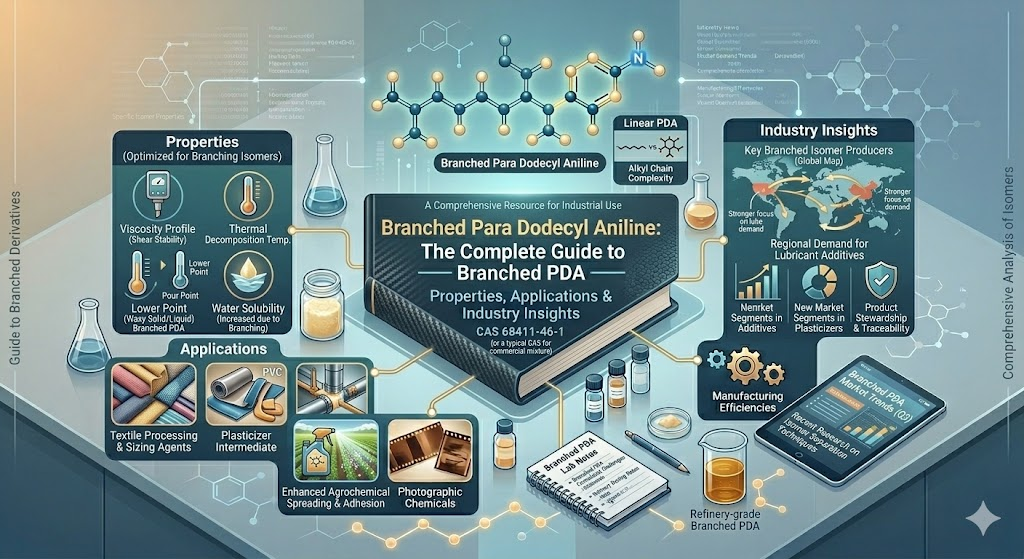
Branched Para Dodecyl Aniline: The Complete Guide to Branched PDA — Properties, Applications & Industry Insights

If you have ever worked with petroleum solvent dyes, lubricant additives, or oilfield corrosion inhibitors, you have almost certainly handled a product built on Branched Para Dodecyl Aniline — even if the spec sheet simply listed it as “branched PDA” or “branched 4-dodecylaniline.” It is one of those foundational intermediates that quietly enables an entire category of high-performance industrial chemicals.

In this guide, we will explain exactly what Branched Para Dodecyl Aniline is, how it differs from its linear counterpart, why the branching matters so much for downstream applications, and what to look for when sourcing it. Whether you are a dye chemist, a lubricant formulator, or a procurement specialist evaluating alkylated amine suppliers, this article is written with you in mind.

What Is Branched Para Dodecyl Aniline?

Branched Para Dodecyl Aniline is an alkylated aromatic amine consisting of an aniline molecule (a benzene ring with an -NH₂ group) where a branched-chain C12 (dodecyl) group is attached at the para position. The molecular formula is C₁₈H₃₁N, the same as the linear form, but the critical difference lies in the structure of the alkyl chain itself.

In the branched variant, the dodecyl group is derived from propylene tetramer — a mixture of branched C12 olefins produced by oligomerising propylene. This gives the chain multiple methyl side-branches rather than a straight, unbranched backbone. The alkylation is carried out via Friedel-Crafts chemistry using Lewis acid catalysts such as aluminium chloride (AlCl₃).

Why does this matter? Because branching dramatically changes the physical behaviour of the molecule. The irregular, branched chain disrupts crystal packing, which lowers the melting point and keeps the product liquid or semi-liquid at ambient temperatures. It also increases solubility in hydrocarbon solvents and non-polar media — a critical advantage for petroleum dye and lubricant additive manufacturing.

Key Properties of Branched Para Dodecyl Aniline

Here is a quick-reference overview:

PropertyDetails
Chemical NameBranched 4-Dodecylaniline (Branched Para Dodecyl Aniline)
CAS Number68411-48-3 (mixed isomers) / related registrations
Molecular FormulaC₁₈H₃₁N
Molecular Weight261.45 g/mol
Chemical ClassBranched alkylated aromatic amine
AppearanceAmber to brown viscous liquid or low-melting waxy solid
Alkyl Chain SourcePropylene tetramer (branched C12 olefins)
SolubilityInsoluble in water; excellent in hydrocarbons, xylene, toluene
Key Functional GroupsPrimary amine (-NH₂), branched dodecyl chain
ReactivityReadily diazotised; undergoes coupling, acylation, Mannich reactions
Advantage vs. Linear PDAHigher oil solubility, lower melting point, better cold stability

Branched vs. Linear Para Dodecyl Aniline: What Is the Difference?

This is one of the most frequently asked questions in the industry. Here is a direct comparison:

ParameterBranched PDALinear PDA (CAS 104-42-7)
Alkyl Chain StructureMultiple methyl branches (from propylene tetramer)Straight unbranched C12 chain (from 1-dodecene)
Melting PointLow — liquid/semi-liquid at room temperatureHigher — waxy solid at room temperature
Oil/Fuel SolubilitySignificantly higherHigh, but lower than branched
Cold Stability of End ProductsSuperior — less prone to crystallisationGood, but may crystallise at low temperatures
BiodegradabilityLower (branching resists beta-oxidation)Higher (linear chain biodegrades more readily)
Typical End UsePetroleum dyes, lubricant additives, corrosion inhibitorsPetroleum dyes, surfactants, R&D applications
CostGenerally comparableGenerally comparable
Best Suited ForClosed industrial systems; maximum solubility neededApplications where biodegradability matters

In summary: if your application demands maximum hydrocarbon solubility and cold-temperature stability — as is the case for petroleum dyes and lubricant additives — Branched Para Dodecyl Aniline is the stronger choice. If biodegradability is a priority (e.g., environmental surfactants), the linear form may be preferred.

Primary Applications of Branched Para Dodecyl Aniline

1. Petroleum Solvent Dye Manufacturing

This is the core application. When Branched Para Dodecyl Aniline is diazotised and coupled with naphthols or phenols, the resulting azo dye inherits the branched C12 chain. This produces dyes with exceptional solubility in fuels, oils, and organic solvents — enabling manufacturers to create concentrated liquid dye solutions (often >50% solids) that remain clear and stable even at sub-zero temperatures. Products like Solvent Red 164, Solvent Yellow 107, and custom fuel dye blends rely on branched PDA-based intermediates for this performance.

2. Lubricant and Fuel Additive Intermediates

The branched amine group can be further reacted (via Mannich condensation, Schiff base formation, or amide coupling) to produce ashless dispersants, antioxidants, and multifunctional lubricant additives. The branched alkyl chain ensures these additives remain fully dissolved in base oils across a wide temperature range.

3. Oilfield Corrosion Inhibitors

Long-chain alkylated amines are well-established corrosion inhibitors in oil and gas production. The amine head adsorbs onto metal surfaces, while the branched hydrophobic tail forms a protective barrier. Branching improves film persistence and coverage compared to linear analogues.

4. Surfactant and Emulsifier Synthesis

Branched PDA serves as a precursor for speciality anionic and non-ionic surfactants used in industrial cleaning, emulsification, and enhanced oil recovery — applications where high hydrocarbon tolerance is valued over biodegradability.

5. Agrochemical Intermediates

Certain herbicide and pesticide formulations use branched alkylated aniline derivatives as intermediates. The branched chain contributes to improved solubility in non-aqueous carriers and adjuvant systems.

Application Overview Table

Application SectorSpecific UseWhy Branched PDA Is Preferred
Petroleum Dye ManufacturingAzo dye intermediate for fuel/oil colouringMaximum solubility in fuels; cold-stable concentrates
Lubricant AdditivesDispersants, antioxidants, multifunctional additivesFull dissolution in base oils across temperature range
Corrosion InhibitorsMetal protection in oilfield and industrial systemsSuperior film formation; hydrophobic barrier
Surfactants / EmulsifiersIndustrial cleaning, emulsification, EORHigh hydrocarbon tolerance
Agrochemical IntermediatesHerbicide/pesticide carrier systemsSolubility in non-aqueous formulations

Case Study: Eliminating Cold-Weather Dye Crystallisation with Branched PDA

Background: A petroleum dye manufacturer supplying fuel colourants to refineries across Northern Europe and Russia was experiencing a recurring seasonal problem. Their red fuel dye product, formulated using a linear PDA-based intermediate, was developing visible crystalline deposits in storage drums during winter months when warehouse temperatures dropped below 0°C.

The Problem: Three refinery customers reported clogged dye injection lines during the 2022–2023 winter season. Two batches were rejected outright for visible sediment. The manufacturer faced contract penalties and reputational damage in a market where product reliability is paramount.

The Solution: The R&D team reformulated the dye by replacing the linear PDA intermediate with Branched Para Dodecyl Aniline sourced from an ISO-certified manufacturer. The branched alkyl chain of the new intermediate produced a dye with significantly disrupted crystal structure, preventing the ordered molecular packing that causes crystallisation at low temperatures.

Results:

MetricBefore (Linear PDA Intermediate)After (Branched PDA Intermediate)
Cold Stability (at -20°C)Crystallisation within 7–14 daysClear and stable for 12+ months
Maximum Concentration in HF Solvent~40% solids~58% solids
Batch Rejections (Annual)50
Injection Line Clogging Incidents8 per winter0
Customer Complaints (Annual)110
Raw Material Cost ImpactBaseline~5% increase (offset by zero returns)

Key Takeaway: The marginal increase in raw material cost was insignificant compared to the eliminated losses from product returns, customer complaints, and contract penalties. This case illustrates the practical performance advantage of Branched Para Dodecyl Aniline over linear PDA in cold-climate petroleum dye applications.

What to Look for When Sourcing Branched Para Dodecyl Aniline

Quality can vary significantly between manufacturers because the branching pattern depends on the specific olefin feedstock and alkylation conditions used. Here is what matters:

Consistent branching profile: The degree and pattern of branching should be consistent between batches. Variability here will cause downstream dye or additive performance to shift unpredictably.

High para-selectivity: The dodecyl group should be predominantly at the para position. Ortho and meta isomers can reduce the reactivity and performance of the final product.

Low colour / low oxidation: Fresh, properly stored Branched PDA should be amber to light brown. Dark brown or black discolouration indicates oxidation or impurities.

Reliable certificate of analysis: Each batch should come with a CoA confirming amine value, moisture content, colour, and purity.

ISO certification: ISO 9001:2015, ISO 14001:2015, and ISO 45001:2018 certifications indicate a manufacturer’s commitment to quality, environmental management, and workplace safety.

Anar Chemicals LLP manufactures Branched Para Dodecyl Aniline alongside a comprehensive range of dye intermediates, petroleum dyes, and speciality chemicals. With over four decades of experience and triple ISO certification, they supply to petroleum dye manufacturers, lubricant additive formulators, and speciality chemical companies globally. Explore their Products page or learn about their CDMO Services for custom synthesis requirements.

Frequently Asked Questions About Branched Para Dodecyl Aniline

Q: What is Branched Para Dodecyl Aniline?

Branched Para Dodecyl Aniline is an alkylated aromatic amine where a branched-chain C12 (dodecyl) group is attached at the para position of the aniline ring. The branching originates from the use of propylene tetramer or branched olefins during Friedel-Crafts alkylation. It is a key intermediate for petroleum dyes, lubricant additives, corrosion inhibitors, and surfactants.

Q: How is Branched Para Dodecyl Aniline different from the linear version?

The key difference is the structure of the C12 alkyl chain. In the branched variant, the dodecyl group contains methyl side branches (from propylene tetramer), whereas the linear version has a straight-chain C12 group from 1-dodecene. Branching increases oil solubility and lowers melting point, but reduces biodegradability compared to linear PDA.

Q: What is the CAS number for Branched Para Dodecyl Aniline?

Branched Para Dodecyl Aniline typically falls under CAS 68411-48-3 (which covers mixed-isomer 4-dodecylaniline) or related registrations depending on the specific branching pattern. The pure linear form is CAS 104-42-7.

Q: Why is branching important for petroleum dye intermediates?

Branching significantly increases solubility in hydrocarbon solvents and fuels. Dyes synthesised from Branched Para Dodecyl Aniline can dissolve at much higher concentrations in xylene, high-flash solvents, and finished fuels — and remain stable at lower temperatures without crystallisation.

Q: What industries use Branched Para Dodecyl Aniline?

The primary industries include petroleum dye manufacturing, lubricant and fuel additive formulation, oilfield corrosion inhibitor production, speciality surfactant synthesis, and agrochemical intermediate manufacturing.

Q: Is Branched Para Dodecyl Aniline biodegradable?

Branched alkyl chains are inherently slower to biodegrade than linear chains, because microorganisms struggle to process the methyl branches via beta-oxidation. For applications like petroleum dyes, lubricant additives, and corrosion inhibitors — where the product remains in a closed industrial system — this is not a practical concern. However, for surfactant applications discharged to the environment, linear variants may be preferred.

Q: Where can I source high-quality Branched Para Dodecyl Aniline?

Branched Para Dodecyl Aniline is available from speciality chemical manufacturers such as Anar Chemicals LLP (anarchem.com), an ISO 9001:2015, ISO 14001:2015 & ISO 45001:2018 certified company with over four decades of experience in dyes, intermediates, and speciality chemicals.

Q: How should Branched Para Dodecyl Aniline be stored?

Store in tightly sealed containers in a cool, dry, well-ventilated area away from oxidising agents and direct sunlight. Use standard aromatic amine handling precautions: protective gloves, eye protection, and adequate ventilation. Always consult the manufacturer’s SDS.

Uncategorized

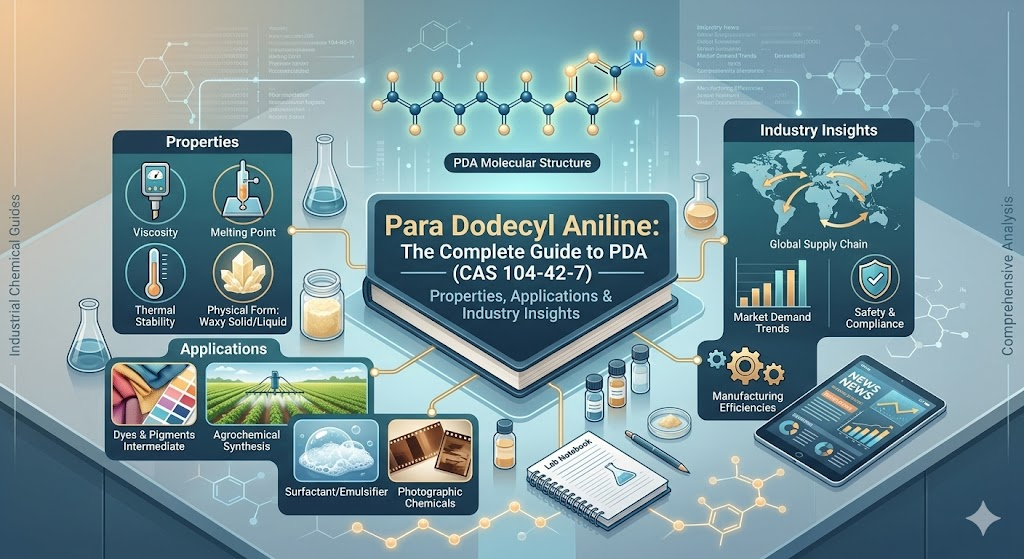
Para Dodecyl Aniline: The Complete Guide to PDA (CAS 104-42-7) — Properties, Applications & Industry Insights

If you work in petroleum dye manufacturing, speciality chemical synthesis, or industrial surfactant production, you have almost certainly come across Para Dodecyl Aniline — even if you know it better as PDA, 4-dodecylaniline, or simply “dodecyl aniline.” It is one of those essential building-block chemicals that rarely gets the spotlight, but without it, an entire category of high-performance petroleum dyes and industrial surfactants simply would not exist.

In this guide, we will break down exactly what Para Dodecyl Aniline is, why its unique molecular structure matters, where it is used across industries, and what to look for when sourcing it. Whether you are a dye chemist formulating petroleum colourants, a procurement specialist evaluating intermediate suppliers, or a researcher exploring alkylated aniline derivatives, this article is for you.

What Exactly Is Para Dodecyl Aniline?

Para Dodecyl Aniline (CAS No. 104-42-7) is an organic compound with the molecular formula C₁₈H₃₁N and a molecular weight of 261.45 g/mol. Structurally, it is an aniline molecule — a benzene ring with an amino (-NH₂) group — where a 12-carbon (dodecyl) straight-chain alkyl group has been substituted at the para position (the 4th carbon of the ring).

This dual nature is what makes Para Dodecyl Aniline so industrially valuable. The aniline “head” is reactive — it can undergo diazotisation, coupling reactions, and other classic aromatic amine chemistry. Meanwhile, the long dodecyl “tail” is hydrophobic, imparting excellent oil solubility and surfactant-like properties to any molecule that incorporates it. In chemical terms, PDA is an amphiphilic molecule: one end is polar, the other is non-polar.

This amphiphilic architecture is precisely why Para Dodecyl Aniline is the intermediate of choice for manufacturing modern liquid petroleum solvent dyes. When PDA is used as a coupling component in azo dye synthesis, the resulting dye inherits the long alkyl chain — giving it dramatically higher solubility in fuels, oils, and organic solvents compared to dyes made from unsubstituted aniline.

Key Chemical Properties of Para Dodecyl Aniline (CAS 104-42-7)

Here is a quick-reference summary of PDA’s essential chemical and physical properties:

PropertyDetails
Chemical Name4-Dodecylaniline (Para Dodecyl Aniline)
CAS Number104-42-7
Molecular FormulaC₁₈H₃₁N
Molecular Weight261.45 g/mol
EC Number203-201-3
Chemical ClassAlkylated aromatic amine
AppearanceWhite to off-white waxy solid or low-melting solid
Boiling Point220–221°C at 15 mmHg
SolubilityInsoluble in water; soluble in ethanol, toluene, xylene, hydrocarbons
Purity (Industrial Grade)≥97%
Key Functional GroupsPrimary amine (-NH₂), dodecyl alkyl chain (-C₁₂H₂₅)
ReactivityReadily diazotised; undergoes coupling, acylation, and alkylation

The combination of reactive amine functionality with a long hydrophobic chain is what makes Para Dodecyl Aniline uniquely suited for applications where both chemical reactivity and oil solubility are required in the end product.

Primary Applications of Para Dodecyl Aniline

1. Petroleum Solvent Dye Manufacturing (The Core Application)

This is where Para Dodecyl Aniline has its biggest industrial impact. Modern petroleum dyes — the liquid solvent dyes used to colour fuels, lubricants, and oils worldwide — are predominantly azo dyes synthesised by diazotising an aromatic amine and coupling it with a naphthol or phenol. When Para Dodecyl Aniline is used as the amine component, the resulting dye carries the long C12 alkyl chain, which gives it exceptional solubility in hydrocarbon solvents.

This is the fundamental reason why today’s liquid petroleum dyes (such as Solvent Red 164, Solvent Yellow 107, and various custom fuel dye blends) can be supplied as concentrated liquid solutions rather than dry powders. The alkyl chain contributed by PDA eliminates the crystallisation and low-solubility problems that plagued earlier-generation petroleum dyes.

2. Surfactant Synthesis

The amphiphilic structure of Para Dodecyl Aniline makes it a valuable starting material for synthesising speciality surfactants. These include sodium 4-dodecylphenylazosulfonate and other anionic or non-ionic surfactants used in industrial cleaning, emulsification, and oilfield chemistry.

3. Corrosion Inhibitor Intermediates

Long-chain alkylated anilines, including PDA, are used in the formulation of corrosion inhibitors for the oil and gas industry. The amine group adsorbs onto metal surfaces, forming a protective film, while the long alkyl chain provides a hydrophobic barrier against corrosive media.

4. Research and Materials Science

In academic and industrial R&D, Para Dodecyl Aniline is used as a building block for liquid crystals, conductive polymers, functionalised nanotubes, and other advanced materials where a long-chain aromatic amine is required.

Application Overview Table

Application SectorSpecific UseRole of PDA
Petroleum Dye ManufacturingAzo dye synthesis for fuel/oil colouringCoupling component; alkyl chain provides fuel solubility
Surfactant ProductionSodium 4-dodecylphenylazosulfonate, etc.Amphiphilic precursor for surface-active agents
Corrosion InhibitorsMetal protection in oilfield and industrial systemsAmine adsorbs to metal; alkyl chain forms hydrophobic barrier
Materials Science / R&DLiquid crystals, conductive polymers, nanotube functionalisationLong-chain aromatic amine building block
Speciality Chemical SynthesisCustom intermediates, agrochemicals, pharma precursorsVersatile alkylated aniline for diverse chemistry

Para Dodecyl Aniline vs. Other Alkylated Anilines

PDA is not the only alkylated aniline used in industry. Here is how it compares with related compounds:

ParameterPara Dodecyl Aniline (PDA)Aniline (Unsubstituted)4-NonylphenolPara Phenylenediamine (PPD)
CAS Number104-42-762-53-3104-40-5106-50-3
Molecular FormulaC₁₈H₃₁NC₆H₇NC₁₅H₂₄OC₆H₈N₂
Alkyl ChainC12 (dodecyl)NoneC9 (nonyl)None
Oil SolubilityExcellentPoorExcellentPoor
Primary Industrial UseDye intermediate, surfactantsPolyurethane, dyes, rubberSurfactants, antioxidantsHair dye, rubber antioxidant
Role in Dye ChemistryCoupling component for oil-soluble azo dyesDiazotisation base for water-soluble dyesCoupling componentOxidation dye base

The key differentiator for Para Dodecyl Aniline is its C12 chain length — long enough to ensure excellent hydrocarbon solubility in the end product, yet short enough to maintain good chemical reactivity at the amine group. This balance is what makes PDA the preferred intermediate for petroleum-grade dye synthesis.

Case Study: Improving Fuel Dye Solubility by Switching to a PDA-Based Dye Intermediate

Background: A mid-size liquid petroleum dye manufacturer in South Asia was experiencing persistent solubility issues with their red fuel dye product. Their existing formulation used a shorter-chain alkylated aniline as the coupling intermediate, which resulted in dyes that would occasionally crystallise out of solution during cold-weather storage (≤ 5°C) and leave deposits in customers’ dosing equipment.

The Problem: Three key customers — all fuel depot operators — reported dye precipitation during winter months, leading to clogged injection lines and inconsistent fuel colouring. The manufacturer risked losing these contracts if they could not deliver a cold-stable product.

The Solution: The R&D team reformulated their red azo dye using Para Dodecyl Aniline (CAS 104-42-7) as the coupling intermediate instead of the shorter-chain variant. The longer C12 alkyl chain from PDA produced a dye with significantly higher solubility in the high-flash solvent base, even at low temperatures.

Results:

MetricBefore (Short-Chain Intermediate)After (PDA-Based Intermediate)
Cold-Weather Stability (5°C)Crystallisation after 2–3 weeksClear and stable for 6+ months
Maximum Solids in Xylene~35%>55%
Customer Complaints (Quarterly)5–70
Dye Injection Clogging Incidents8 per winter season0
Raw Material Cost ImpactBaseline~6% increase (offset by fewer returns)
Customer RetentionAt risk (3 accounts)All 3 accounts retained and expanded

Key Takeaway: The slightly higher cost of Para Dodecyl Aniline as a raw material was more than offset by the elimination of product returns, customer complaints, and reputational risk. This case demonstrates why PDA has become the industry-standard intermediate for modern petroleum dye manufacturing.

What to Look for When Sourcing Para Dodecyl Aniline

Not all PDA is equal. Since the product is synthesised via Friedel-Crafts alkylation of aniline with dodecene, the quality of the final product depends heavily on reaction selectivity and purification. Here is what matters:

Purity (≥97%): Lower-purity PDA contains isomeric by-products and unreacted starting materials that can reduce the performance of downstream dyes and intermediates. Insist on batch-specific certificates of analysis.

Para-selectivity: The dodecyl group must be predominantly in the para position for optimal dye synthesis. Ortho-substituted by-products can cause undesirable colour shifts or reduced solubility.

Consistent colour and form: High-quality PDA should be a white to off-white solid. Significant discolouration (brown or dark yellow) may indicate oxidation or impurities.

Reliable supply chain: PDA is used in continuous production processes. Inconsistent supply or variable quality can disrupt manufacturing schedules downstream.

ISO certification: Manufacturers holding ISO 9001:2015, ISO 14001:2015, and ISO 45001:2018 certifications demonstrate commitment to quality, environmental responsibility, and safety.

Anar Chemicals LLP is an established manufacturer of dyes, intermediates, and speciality chemicals with over four decades of experience. They are ISO 9001:2015, ISO 14001:2015 & ISO 45001:2018 certified and operate dedicated multipurpose plants for dye intermediates. Explore their Products page or learn more about their Infrastructure to understand their manufacturing capabilities.

Frequently Asked Questions About Para Dodecyl Aniline

Q: What is Para Dodecyl Aniline?

Para Dodecyl Aniline (4-dodecylaniline, CAS 104-42-7) is an organic chemical intermediate consisting of an aniline molecule with a 12-carbon (dodecyl) alkyl chain attached at the para position. It is used as a key building block in the synthesis of petroleum solvent dyes, surfactants, corrosion inhibitors, and speciality chemicals.

Q: What is the CAS number for Para Dodecyl Aniline?

The CAS number for Para Dodecyl Aniline is 104-42-7. It is also known as 4-dodecylaniline, p-dodecylaniline, or PDA.

Q: Why is Para Dodecyl Aniline important for petroleum dye manufacturing?

Para Dodecyl Aniline is used as a coupling component in the synthesis of azo-based petroleum solvent dyes. Its long dodecyl chain dramatically improves the solubility of the resulting dye in fuels, oils, and other hydrocarbon solvents — which is the critical performance requirement for modern liquid petroleum dyes.

Q: What is the molecular formula of Para Dodecyl Aniline?

The molecular formula is C₁₈H₃₁N, with a molecular weight of 261.45 g/mol.

Q: Is Para Dodecyl Aniline soluble in water?

No. Due to its long hydrophobic alkyl chain, Para Dodecyl Aniline is practically insoluble in water. It is, however, soluble in organic solvents such as ethanol, toluene, xylene, and various hydrocarbon solvents.

Q: What purity levels are available for Para Dodecyl Aniline?

Industrial-grade Para Dodecyl Aniline is typically available at 97% purity or higher. For speciality synthesis applications, higher-purity grades may be sourced on request from experienced manufacturers.

Q: Where can I buy high-quality Para Dodecyl Aniline?

Para Dodecyl Aniline is available from speciality chemical manufacturers such as Anar Chemicals LLP (anarchem.com), an ISO 9001:2015, ISO 14001:2015 & ISO 45001:2018 certified company with over 40 years of experience in dyes, intermediates, and speciality chemicals.

Q: How should Para Dodecyl Aniline be handled and stored?

Like most aromatic amines, Para Dodecyl Aniline should be handled with standard chemical safety precautions — protective gloves, eye protection, and adequate ventilation. Store in tightly sealed containers in a cool, dry place away from oxidising agents. Always consult the manufacturer’s SDS for specific guidelines.

Uncategorized

Blue 79: The Complete Guide to Solvent Blue 79 (CAS 64553-79-3) — Properties, Applications & Industry Insights

When you see a distinctively blue-tinted fuel at a depot, or a lubricant that carries a deep blue colour right out of the drum, there is a very good chance Blue 79 is responsible. Solvent Blue 79 (CAS No. 64553-79-3) is one of the most widely used blue petroleum dyes in the world — an anthraquinone-based colourant that was specifically engineered for exceptional solubility in fuels, oils, and organic solvents.

In this guide, we will cover everything you need to know about Blue 79: its chemistry and origins, why it replaced older blue dyes, where it is used today, and what to look for when sourcing it. If you are involved in fuel blending, lubricant manufacturing, or industrial dye procurement, this article is written with you in mind.

What Exactly Is Blue 79?

Blue 79, officially designated C.I. Solvent Blue 79, is a synthetic anthraquinone dye with the CAS number 64553-79-3. Its core chemical description is 9,10-anthracenedione, 1,4-diamino-, with N, N-mixed 2-ethylhexyl, methyl, and pentyl derivatives.

Here is the key backstory: Blue 79 was originally developed by BASF as a high-solubility form of Solvent Blue 35 (also known as Oil Blue 35 or 1,4-bis(butylamino)anthraquinone). The older Solvent Blue 35 works well as a blue colourant, but in powder form it dissolves only up to about 2% in xylene — far too low for efficient industrial use. By adding longer, branched alkyl side chains to the anthraquinone molecule, BASF created Blue 79, which can form stable liquid solutions at concentrations exceeding 60% solids in xylene, remaining stable even down to -20°C.

This dramatic improvement in solubility was a game-changer. It meant refineries could work with a ready-to-use liquid dye instead of handling hazardous powders — safer, faster, and far more consistent in application.

Key Chemical Properties of Blue 79 (CAS 64553-79-3)

The table below provides a quick-reference overview of the essential properties of Blue 79:

PropertyDetails
C.I. NameSolvent Blue 79
CAS Number64553-79-3
Chemical ClassAnthraquinone (1,4-diaminoanthraquinone derivative)
Base ChromophoreSame as Solvent Blue 35
HueReddish Blue
SolubilityOil-soluble; >60% in xylene; fully miscible in fuels
Physical FormLiquid (in solvent)
Common SolventsHigh-flash (HF) solvents, Xylene (XY)
Recommended Dosage10–20 ppm in petroleum products
Shelf Life~2 years (stored at 5–40°C, sealed containers)
Key AdvantageDramatically higher solubility vs. Solvent Blue 35 powder
Commercial NamesSudan Blue 673 (BASF), Sudan Blue B, Automate Blue ER, Dyeguard Blue 79

These properties make Blue 79 the default choice for any petroleum or industrial application requiring a reliable, high-performance blue dye in liquid form.

Primary Applications of Blue 79

1. Fuel and Petroleum Colour-Coding

The dominant application for Blue 79 is colouring petroleum fuels. Refineries worldwide use it to colour-code specific fuel grades — distinguishing different octane levels of gasoline, various diesel sulphur grades, aviation fuels, kerosene, and gas oil. In some jurisdictions, blue-dyed diesel is specifically designated for governmental and institutional vehicles, making it easy to detect fuel theft or misuse.

Blue 79 is also a key ingredient in green fuel dye formulations. Because green is produced by combining a blue dye with a yellow dye (typically Solvent Yellow 107), Blue 79 is used alongside yellow dyes to achieve the precise green shade required by certain national fuel-marking regulations.

2. Lubricants, Hydraulic Fluids, and Industrial Oils

Transmission fluids, gear oils, hydraulic oils, and cutting fluids are often coloured blue for brand differentiation and product identification. Blue 79 provides a clean, vivid blue that remains stable over long storage periods and does not degrade under the thermal conditions typical of working machinery.

3. Wax, Candle, and Speciality Product Colouring

Blue 79 dissolves cleanly in paraffin and other wax systems, making it a reliable option for candle manufacturers who need a deep, consistent blue without sediment or wick-clogging issues.

4. Printing Inks and Coatings

In oil-based ink systems, Blue 79 delivers strong tinting strength and rapid dispersion. Its anthraquinone structure also provides inherently better lightfastness compared to azo-based dyes, which is an advantage for certain ink and coating applications exposed to sunlight.

Application Overview Table

Application SectorSpecific UseWhy Blue 79 Is Preferred
Fuel & PetroleumGasoline, diesel, kerosene, aviation fuelExceptional solubility, consistent hue, liquid-to-liquid handling
Green Fuel DyesMixed with Solvent Yellow 107 for green shadesPrecise colour control, stable blend
Lubricants & FluidsTransmission fluid, hydraulic oil, gear oilThermal stability, no residue, vivid colour
Wax & CandlesParaffin, soy wax, gel wax colouringClean dissolution, no wick clogging
Printing InksOil-based ink formulationsStrong tinting, good lightfastness

Blue 79 vs. Other Common Blue Solvent Dyes

How does Blue 79 compare with other blue dyes used in the petroleum and industrial sectors? Here is a side-by-side look:

ParameterBlue 79Solvent Blue 35Solvent Blue 98Solvent Blue 97
CAS Number64553-79-317354-14-274499-36-832724-62-2
Chemical ClassAnthraquinone (alkylated)Anthraquinone (base)AnthraquinoneAnthraquinone
Physical FormLiquidPowderLiquidPowder
Solubility in Xylene>60%~2%HighModerate
Primary UseFuel & oil colouringFuel, wax, inks, stainsFuel & oil colouringPlastics (PS, PET, PC, ABS)
HueReddish blueBlueBlueGreenish blue
LightfastnessGoodGoodGoodVery good (7–8)
Handling SafetyLiquid — lower riskPowder — dust hazardLiquid — lower riskPowder — dust hazard

The core advantage of Blue 79 over the original Solvent Blue 35 comes down to practicality: the liquid form eliminates powder-handling hazards, ensures instant dispersion, and allows for far more accurate dosing in automated injection systems.

Case Study: Improving Fuel Depot Safety and Efficiency with Blue 79

Background: A national oil marketing company operating a network of fuel storage depots across the Middle East was experiencing recurring issues with their blue fuel dye programme. Their existing setup relied on Solvent Blue 35 in powder form, which required manual weighing and pre-dissolution in small batches of xylene before injection into fuel storage tanks. The process was slow, generated significant dye dust exposure for workers, and produced inconsistent colour from batch to batch.

The Problem: Depot workers were raising health and safety concerns about repeated exposure to powdered anthraquinone dye dust. Quality audits revealed that colour intensity varied by up to 35% between tanks that had been dyed using the powder process, and three batches in a single quarter had been rejected for insufficient blue tinting.

The Solution: The company transitioned to a pre-formulated Solvent Blue 79 (CAS 64553-79-3) liquid concentrate supplied in high-flash solvent base. The liquid was delivered in sealed drums, eliminating all powder handling. It was injected directly into the fuel flow using the existing proportional dosing systems at each depot, calibrated to deliver 15 ppm of Blue 79.

Results:

MetricBefore (Blue 35 Powder)After (Blue 79 Liquid)
Colour Consistency±35% variation±4% variation
Batch Rejection Rate~8% per quarter0% (12 months post-switch)
Worker Dust Exposure Incidents6 per year0
Dye Dissolution Time45–60 min per batchInstant (pre-dissolved)
Annual Dye Handling CostBaseline~22% reduction
HSE Audit Findings (Dye-Related)3 in 12 months0 in 12 months

Key Takeaway: The switch from powdered Solvent Blue 35 to liquid Blue 79 did not just improve colour consistency — it fundamentally improved workplace safety and operational efficiency. This is exactly the kind of gain that the shift from powder to liquid petroleum dyes was designed to achieve, and it is why Blue 79 has become the industry standard for blue fuel colouring.

What to Look for When Sourcing Blue 79

Because Blue 79 is a mixture of alkylated anthraquinone derivatives (not a single pure compound), product quality and performance can vary between manufacturers. Here are the criteria that matter most:

Zero insolubles: The liquid dye should be completely free of undissolved particles. Even trace insolubles can accumulate in fuel injection lines, dosing pumps, and storage tank filters.

Full miscibility: Blue 79 must dissolve instantly and completely in the target fuel or oil, producing a clear, homogeneous blue with no haziness.

Colour strength consistency: Batch-to-batch colour strength should be verified spectrophotometrically. A reliable manufacturer will provide a certificate of analysis confirming dye content and colour strength for every production batch.

Low-temperature stability: The liquid formulation should remain clear and stable at temperatures down to at least -20°C, without crystallisation or phase separation.

ISO certification: Look for manufacturers with ISO 9001:2015, ISO 14001:2015, and ISO 45001:2018 certifications as evidence of quality, environmental, and safety management.

Anar Chemicals LLP manufactures Blue 79 in both high-flash and xylene solvent bases, backed by over four decades of experience in dyes and speciality chemicals. They are an ISO 9001:2015, ISO 14001:2015 & ISO 45001:2018 certified facility, supplying petroleum dye solutions to refineries and fuel companies globally. You can explore their complete Liquid Petroleum or Fuel Dyes range on their website.

Frequently Asked Questions About Blue 79

Q: What is Blue 79 used for?

Blue 79 (Solvent Blue 79, CAS 64553-79-3) is primarily used for colouring petroleum fuels, lubricants, and industrial oils to enable visual identification and grade differentiation. It is also used in wax, candle, and ink formulations that require a stable blue hue in non-aqueous systems.

Q: What is the CAS number for Blue 79?

Solvent Blue 79 is listed under CAS number 64553-79-3. This is the standard CAS registration for the alkylated 1,4-diaminoanthraquinone derivative used in petroleum dye formulations.

Q: How is Blue 79 different from Solvent Blue 35?

Blue 79 is the high-solubility, alkylated form of Solvent Blue 35. Both share the same anthraquinone chromophore and produce similar blue hues, but Blue 79 has longer alkyl side chains that dramatically improve its solubility in fuels and organic solvents. Solvent Blue 35 in powder form dissolves only up to about 2% in xylene, while Blue 79 can form stable solutions at concentrations above 60%.

Q: What is the typical dosage for Blue 79 in fuel?

Blue 79 is typically used at 10 to 20 ppm in petroleum products, though the exact dosage depends on the target shade intensity and the specific fuel or oil being coloured.

Q: Does Blue 79 affect fuel performance?

No. Solvent Blue 79 is chemically inert in hydrocarbon systems at the concentrations used. It does not alter combustion characteristics, octane or cetane ratings, or engine performance.

Q: Why do refineries use blue fuel dyes?

Blue fuel dyes serve multiple purposes: differentiating fuel grades during storage and transport, identifying governmental or institutional-use fuel to prevent theft, and meeting country-specific regulatory requirements for fuel colour-coding.

Q: Where can I buy high-quality Blue 79?

Blue 79 is available from speciality petroleum dye manufacturers such as Anar Chemicals LLP (anarchem.com), an ISO 9001:2015, ISO 14001:2015 & ISO 45001:2018 certified company with over 40 years of experience. They produce Blue 79 in both high-flash and xylene solvent bases.

Q: How should Blue 79 be stored?

Store in tightly sealed containers, away from direct sunlight, at temperatures between 5°C and 40°C. Under proper conditions, the shelf life is approximately 2 years from the date of manufacture.

Uncategorized

Yellow 107: The Complete Guide to Solvent Yellow 107 (CAS 67990-27-6) — Properties, Applications & Industrial Insights

If you have ever wondered what gives certain petroleum products their distinctive yellow tint — or how refineries tell one fuel grade from another at a glance — there is a good chance Yellow 107 is part of the answer. Solvent Yellow 107 (CAS No. 67990-27-6) is a workhorse dye in the global petroleum industry, quietly doing its job in fuel tanks, lubricant drums, and wax processing lines around the world.

In this guide, we will walk through everything you need to know about Yellow 107 — from its chemical makeup and performance characteristics to its real-world applications and how it compares with other yellow solvent dyes. Whether you are a fuel blender, a procurement specialist, or someone researching dye options for an industrial project, this article has you covered.

What Exactly Is Yellow 107?

Yellow 107, officially designated C.I. Solvent Yellow 107 (Colour Index No. 21140), is a synthetic double-azo dye with the CAS number 67990-27-6. Its molecular formula is C₄₄H₅₈N₄O₂, and it has a molecular weight of 674.96 g/mol. The dye is manufactured by double diazotisation of 3,3′-dimethylbenzidine, followed by coupling with 4-nonylphenol.

In appearance, Yellow 107 produces a warm, reddish-yellow hue and is fully oil-soluble — meaning it dissolves in hydrocarbon-based solvents, petroleum products, and non-polar media without any cloudiness or residue. It is commercially available in liquid form, typically formulated in high-flash solvents, xylene or toluene solvent systems.

What makes Yellow 107 particularly useful is its combination of strong tinting strength, excellent solubility across a range of petroleum products, and good thermal stability. It does not affect the functional properties of the fuels or oils it colours, which is exactly what the industry demands.

Key Chemical Properties of Yellow 107 (CAS 67990-27-6)

Here is a quick-reference summary of the essential chemical and physical properties of Yellow 107:

PropertyDetails
C.I. NameSolvent Yellow 107
C.I. Number21140
CAS Number67990-27-6
Chemical ClassDiazo (Double Azo)
Molecular FormulaC₄₄H₅₈N₄O₂
Molecular Weight674.96 g/mol
HueReddish Yellow
SolubilityOil-soluble; fully miscible in petroleum products
Physical FormLiquid (in solvent)
Common SolventsHigh-flash (HF), Xylene (XY), Toluene
Recommended Dosage10–20 ppm
Shelf Life2 years (stored at 5–40°C in closed containers)
Synthesis3,3′-Dimethylbenzidine diazotisation + 4-nonylphenol coupling

These characteristics make Yellow 107 a reliable choice for any application that needs a stable, vivid yellow colourant in a non-aqueous, hydrocarbon-based system.

Primary Applications of Yellow 107

1. Fuel and Petroleum Product Colour-Coding

The single biggest application for Yellow 107 is in the petroleum industry. Refineries and fuel distributors use it to colour-code different grades and types of fuel — distinguishing leaded from unleaded gasoline, high-octane from low-octane fuel, or different sulphur-level diesel grades. This colour differentiation is not just cosmetic; it is a critical safety and compliance measure that prevents dangerous mix-ups during storage, transportation, and dispensing.

Different countries mandate specific dye colours and concentrations for various fuel types. Yellow 107 is widely used across Asia, Africa, and the Middle East for these fuel identification programmes, and it is one of the key yellow dyes approved for petroleum colouring in India and several other markets.

2. Lubricants, Greases, and Industrial Oils

Manufacturers of transmission fluids, hydraulic oils, gear oils, and industrial lubricants use Yellow 107 to impart a consistent, recognisable colour to their products. This helps end-users identify the product type at a glance and also serves as a brand differentiator in a competitive market.

3. Wax, Candle, and Speciality Product Colouring

Yellow 107 dissolves cleanly in paraffin and other wax bases, making it a popular choice for candle and wax product manufacturers who need a bright, stable yellow. Its high solubility means no sediment, no clogging of wicks, and no uneven colour distribution.

4. Printing Inks and Coatings

In oil-based printing ink formulations, Yellow 107 provides strong tinting strength and fast dispersion, allowing for uniform colour output even at low concentrations.

Application Overview Table

Application SectorSpecific UseWhy Yellow 107 Is Preferred
Fuel & PetroleumGasoline, diesel, kerosene, gas oilFull miscibility, regulatory approval, consistent hue
Lubricants & FluidsTransmission fluid, hydraulic oil, gear oilNo residue, stable colour, brand differentiation
Wax & CandlesParaffin, soy, and gel wax colouringClean dissolution, bright finish, no wick clogging
Printing InksOil-based ink formulationsStrong tinting strength, fast dispersion
Industrial OilsCutting oils, mineral oils, heat transfer oilsThermal stability, inert at working temperatures

Yellow 107 vs. Other Common Yellow Solvent Dyes

There are several yellow solvent dyes available on the market. How does Yellow 107 stack up? Here is a side-by-side comparison with three commonly encountered alternatives:

ParameterYellow 107Yellow 124Yellow 14Yellow 56
CAS Number67990-27-634432-92-3842-07-92481-94-9
Chemical ClassDouble AzoAzoMono AzoAzo
Primary UseFuel/oil colour-codingEU Euromarker (fiscal)Wax, shoe polish, oilsHeating oil, fuel marking
HueReddish yellowYellow (near-colourless at low ppm)Orange-yellowYellow
Solubility in FuelExcellentGoodModerateGood
Tinting StrengthHighLow (marker, not visual dye)ModerateModerate
Dosage (Fuel)10–20 ppm6–9 mg/L (EU mandated)VariesVaries
Regulatory RoleVisual colour-codingFiscal marker (EU)General industrialGeneral fuel dye

The key takeaway: Yellow 107 is designed for strong visual colouring of petroleum products, whereas Yellow 124 serves as a near-invisible fiscal marker. They play entirely different roles and are often used alongside each other in fuel marking programmes.

Case Study: Standardising Fuel Colour-Coding for an Indian Petroleum Distributor

Background: A mid-size petroleum distributor operating across western India was facing recurring issues with fuel identification at their depot network. Different terminals were using dyes sourced from multiple local suppliers, leading to noticeable colour inconsistencies between batches of the same fuel grade. During a regulatory inspection, auditors flagged that the yellow tinting in their branded kerosene varied significantly across three depots — some batches appeared pale straw-coloured, while others were a deep amber.

The Problem: The inconsistency created confusion among depot workers and raised concerns about possible adulteration. The distributor needed a single, reliable yellow dye solution that would deliver uniform colour across all locations without requiring changes to their existing blending infrastructure.

The Solution: The distributor consolidated their yellow dye supply with a single ISO-certified manufacturer producing Yellow 107 (CAS 67990-27-6) in a high-flash solvent base. The new formulation was pre-calibrated for a standard dosage of 15 ppm, delivered in ready-to-use liquid form that could be injected directly into fuel lines without pre-dilution.

Results:

MetricBefore (Multiple Suppliers)After (Single Yellow 107 Source)
Colour Consistency (visual)Significant variation across depotsUniform across all 7 depots
Batch Rejection Rate~12%<1%
Supplier Count4 different dye vendors1 ISO-certified manufacturer
Dosage StandardisationVaried (8–25 ppm)Fixed at 15 ppm
Annual Dye CostBaseline~14% reduction (volume pricing)
Regulatory Audit Flags2 in 12 months0 in 12 months

Key Takeaway: Consolidating to a single, quality-assured Yellow 107 supply eliminated the batch-to-batch variation that had been causing compliance headaches. The experience underscores a principle that holds true across the petroleum dye industry: consistency of supply matters just as much as the chemical itself.

What to Look for When Sourcing Yellow 107

Because Yellow 107 is a commercial dye and not a single pure compound (the alkylation and coupling process produces a mixture of related structures), quality can vary significantly between manufacturers. Here are the factors that matter most:

Impurity-free formulation: The product should be completely free of insoluble particles. Even trace amounts of insoluble matter can accumulate in fuel injection systems and storage tanks over time.

Full miscibility: Yellow 107 must dissolve completely in the target fuel or oil product, producing a clear, homogeneous colour with no haziness or phase separation.

Batch-to-batch consistency: Look for manufacturers who perform spectrophotometric quality checks on every production batch to ensure consistent colour strength and hue.

Flexible solvent bases: Depending on your application, you may need Yellow 107 in a high-flash solvent, xylene, or toluene base. A capable manufacturer will offer all three options.

ISO certification: Manufacturers holding ISO 9001:2015, ISO 14001:2015, and ISO 45001:2018 certifications are demonstrating commitment to quality, environmental compliance, and safety.

Anar Chemicals LLP is an established manufacturer that ticks all of these boxes — ISO 9001:2015, ISO 14001:2015 & ISO 45001:2018 certified, with over four decades of experience in dyes and speciality chemicals. They produce Yellow 107 in high-flash, xylene, and toluene solvent bases and supply to petroleum companies across the globe. Explore their full Liquid Petroleum or Fuel Dyes product range for more details.

Frequently Asked Questions About Yellow 107

Q: What is Yellow 107 used for?

Yellow 107 (Solvent Yellow 107, CAS 67990-27-6) is primarily used for colouring and differentiating petroleum products such as fuels, lubricants, and industrial oils. It is also used in wax colouring, candle manufacturing, printing inks, and certain plastic formulations.

Q: What is the CAS number for Yellow 107?

The CAS number for Solvent Yellow 107 is 67990-27-6. Its Colour Index number is C.I. 21140.

Q: Is Yellow 107 the same as Solvent Yellow 124?

No. Yellow 107 (CAS 67990-27-6) and Solvent Yellow 124 (CAS 34432-92-3) are chemically different dyes with distinct structures and applications. Solvent Yellow 124 was used as the EU Euromarker for tax-exempt fuel identification, while Yellow 107 is primarily used for visual fuel colour-coding and industrial colouring. They serve complementary but separate roles.

Q: What is the typical dosage for Yellow 107 in fuel?

Yellow 107 is generally used at a dosage of 10 to 20 parts per million (ppm) in petroleum products, depending on the desired shade intensity and the specific product being coloured.

Q: Does Yellow 107 affect fuel performance or engine operation?

No. Solvent Yellow 107 is chemically inert in hydrocarbon systems at the concentrations used for colouring. It does not alter combustion characteristics, octane or cetane ratings, or the mechanical performance of engines.

Q: How should Yellow 107 be stored?

Yellow 107 should be stored in tightly closed containers, away from direct sunlight, at temperatures between 5°C and 40°C. Under these conditions, the product has a shelf life of approximately 2 years from the date of manufacture.

Q: Where can I buy high-quality Yellow 107?

Yellow 107 is available from speciality chemical manufacturers such as Anar Chemicals LLP (anarchem.com), an ISO-certified company with over four decades of experience in petroleum dyes and speciality chemicals. They produce Yellow 107 in high-flash, xylene, and toluene solvent bases.

Q: Is Yellow 107 safe to handle?

Like most industrial solvent dyes, Yellow 107 should be handled with standard precautions — protective gloves, eye protection, and adequate ventilation. Always consult the manufacturer’s Safety Data Sheet (SDS/MSDS) for product-specific safety information.