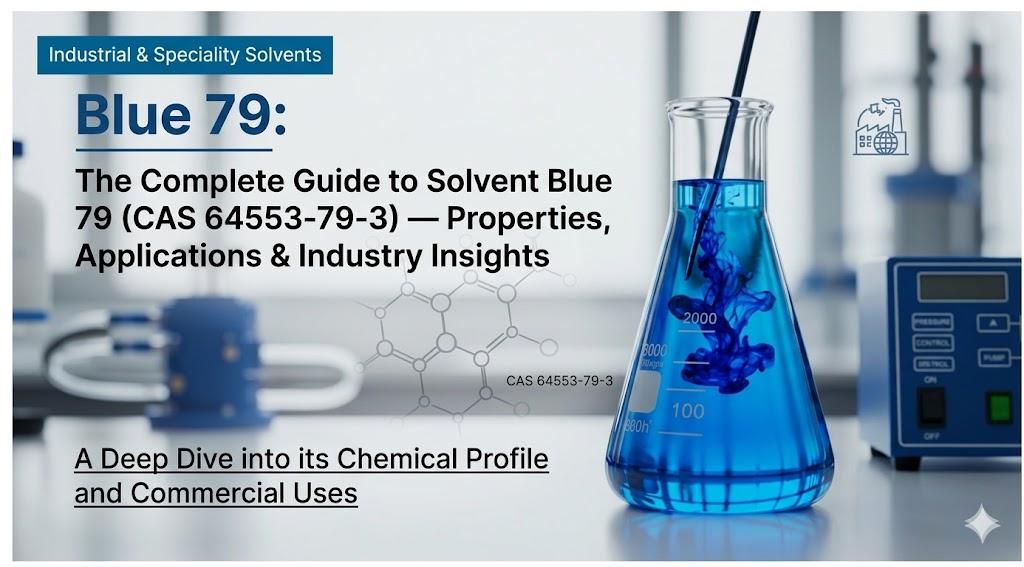
If at the fuel depot you encounter a specialized blue colour, and while removing it from the drum you see that the lubricant has a very intense bluish-blackish colour, then it is 99% certain that you have Blue 79 on your hands. Blue 79 is the best-known colourant within Solvent Blue petroleum blue dyes, a highly soluble anthraquinone dye that was developed exclusively for use within fuels, oils, and other solvent-based applications.
In this post, we’ll take you through the basics of Blue 79: what it is and its history, how it came to replace the old blue dyes, where you’ll find it today, and how to buy it. Whether you’re a fuel blender, lubricant manufacturer, or industrial dye buyer, this article has you covered.
What Exactly Is Blue 79?
Blue 79 (CAS 64553-79-3) is a synthetic anthraquinone dye. Its chemical name is 9,10-anthracenedione, 1,4-diamino-, N, N-mixed 2-ethylhexyl-, methyl-, and pentyl-derivs. The key backstory: Originally, Blue 79 was developed by BASF as a highly soluble form of Solvent Blue 35 (Oil Blue 35, 1,4-bis(butylamino)anthraquinone), which is a very good blue dye but only dissolves to around 2% in xylene (which makes it pretty useless industrially) BASF added a second side-chain of longer, more branched alkyls onto the anthraquinone molecule, producing Blue 79 which can form stable liquid solutions at over 60% solids in xylene and remain at room temperature down to -20°C.
This leap in solubility was huge. It meant refineries could drop the more hazardous powder for a liquid dye that was safe to use, easy to apply and very predictable.
Primary Applications of Blue 79
1. Fuel and Petroleum Colour-Coding
Blue 79 has been primarily used in the coloration of petroleum-based fuels. Refining companies globally rely on the use of this dye to differentiate various grades of fuel, including different octane levels of gasoline, sulphur grades of diesel, aviation fuels, kerosene and gas oil. In certain areas, blue dye for diesel is reserved solely for government- and state-owned vehicles.
Blue 79 plays a vital role in green fuel dye formulas. Blue is a fundamental component of green fuel dye formulas. Since green is created by mixing a blue dye with a yellow dye (generally Solvent Yellow 107) Blue 79 is added to yellow dyes to replicate the exact green color specified by some national fuel-marking standards.
2. Lubricants, Hydraulic Fluids, and Industrial Oils
For product identification and differentiation, transmission fluids, gear oils, hydraulic oils, and cutting fluids are frequently dyed blue. A clean, bright blue that does not deteriorate after a long period in storage and is not affected by the typical heat seen by normally functioning machinery is available from Blue 79.
3. Wax, Candle, and Speciality Product Colouring
For colouring candles, waxes, and other specialised materials, when diluted in paraffin and other wax systems, Blue 79 is simple to dissolve.
4. Printing Inks and Coatings
Blue 79 has high tinting strength and fast dispersion in oil-based inks. The anthraquinone structure also offers inherently improved lightfastness over azo-based dyes, which is an advantage in some ink and coating applications that are exposed to sunlight.
Case Study: Improving Fuel Depot Safety and Efficiency with Blue 79
Background: A country oil marketing company with a chain of fuel storage depots throughout the Middle East was facing constant problems with their blue fuel dye programme. Their Blue dye system at the time used a powder of solvent blue 35 that had to be manually weighed out and pre-dissolved on-site in batches of small quantities of xylene prior to being injected into fuel storage tanks. This system was slow, exposed staff to large quantities of dye dust, and resulted in inconsistent coloured dye from batch to batch.
The Problem: Depot workers had already raised safety concerns about prolonged inhalation of the powder form of the dye, and during quality audits it was discovered that colour levels varied by 35% between tanks that had been dyed with powder and that three batches in one quarter had been rejected due to lack of a strong blue tint.
The Solution: The company switched to a pre-prepared Solvent Blue 79 (CAS 64553-79-3) liquid concentrate in a high-flash solvent base. The concentrate is packaged in sealed drums and therefore removes all handling of powder products. The concentrate was dosed directly into the fuel flow using the current proportional dosing systems installed at each depot and was accurately proportioned to 15ppm of Blue 79.
Key Takeaway: The transition from powdered Solvent Blue 35 to liquid Blue 79 was not merely about the consistency of colour – it was an important step in protecting the safety of the workplace and, as a result, efficiency. That’s the very benefit that the move from powder to liquid petroleum dyes was intended to provide. That is why Blue 79 has been adopted as the industry standard.
What to Look for When Sourcing Blue 79
Because Blue 79 is not a pure compound but rather a blend of alkylated anthraquinone derivatives, variations in product quality and performance can exist among different manufacturers. These are the key qualities to look for:
- No insolubles: Your dye should be a pure liquid with no solids suspended in it. Insolubles build up in injection line filters, dosing pumps, and storage tanks.
- Instantly and Completely Dissolve: Your dye should instantly & completely dissolve in the material that you are going to use the dye in to form a clear, consistent hue of blue.
- Colour strength consistency: Check that all production batches have been tested at a recognised laboratory for colour strength with a spectrophotometer. The correct dye dosage and colour strength should be available on a certificate of analysis for all production batches.
- Freeze stability: The liquid should be stable at temperatures of -20°C and below for crystallisation or phase separation to occur.
- ISO certification: Seek out manufacturers who have ISO 9001:2015, ISO 14001:2015, and ISO 45001:2018 quality, environmental, and safety standards.
Anar Chemicals LLP has been a creator of Blue 79 in high-flash and xylene solvent base for more than 40 years as a dye and speciality chemicals manufacturing company. They are an ISO 9001:2015, ISO 14001:2015 & ISO 45001:2018 certified company providing a full range of petroleum dye products for refineries and fuel companies around the world. Check out their entire Liquid Petroleum or Fuel Dyes collection online.
Frequently Asked Questions About Blue 79
What is Blue 79 dye used for?
Blue 79 (Solvent Blue 79 – CAS 64553-79-3) is used in petroleum fuels, lubricants, and industrial oils (and their formulations) for colouring to facilitate visual identification and distinction between grades. It is also used in candles, wax, and ink systems, which require a blue colour stable in non-aqueous media.
What is the CAS number for Blue 79?
CAS number 64553-79-3. This is the CAS registration for the alkylated 1,4-diaminoanthraquinone derivative that is used in petroleum dye formulations.
What is the recommended dosage of Blue 79 in fuel?
Blue 79 is used at approximately 10 to 20 ppm in petroleum products, although this dosage will vary depending on the desired shade and the coloured fuel/oil.
What is the difference between Blue 79 and Solvent Blue 35?
Blue 79 is an alkylated, high-solubility version of Solvent Blue 35. They are identical except Blue 79 has longer alkyl side chains that greatly increase the solubility of the dye in fuels and other organic solvents. Solvent Blue 35 in powder form dissolves just under 2% in xylene, whereas Blue 79 can stabilize solutions well above 60%.
Blue 79 fuel – does it impact fuel performance?
No. Blue 79 is insoluble in hydrocarbons, and it is added at such a low concentration that it does not influence combustion behaviour, octane/cetane number, or performance.
Why do refineries dye fuel blue?
Blue fuel dyes have many uses: distinguishing fuel quality grades during storage and transportation, for national fuel data collection, preventing theft of government stockpiles, and for the colour-coding regulations of the country in question.
Where can I buy the best Blue 79?
Blue 79 is also manufactured by speciality petroleum dye manufacturers, such as Anar Chemicals LLP (anarchem.com), an ISO 9001:2015,ISO 14001:2015 & ISO 45001:2018 certified company that manufactures a wide range of dyes, with over 40 years of product experience. Blue 79 is manufactured in high-flash and xylene solvent bases.
How do I store Blue 79?
Store in a tightly sealed bottle, away from direct sunlight, at temperatures between 5C and 40C. The shelf life, stored correctly, is approximately 2 years from date of manufacture.