
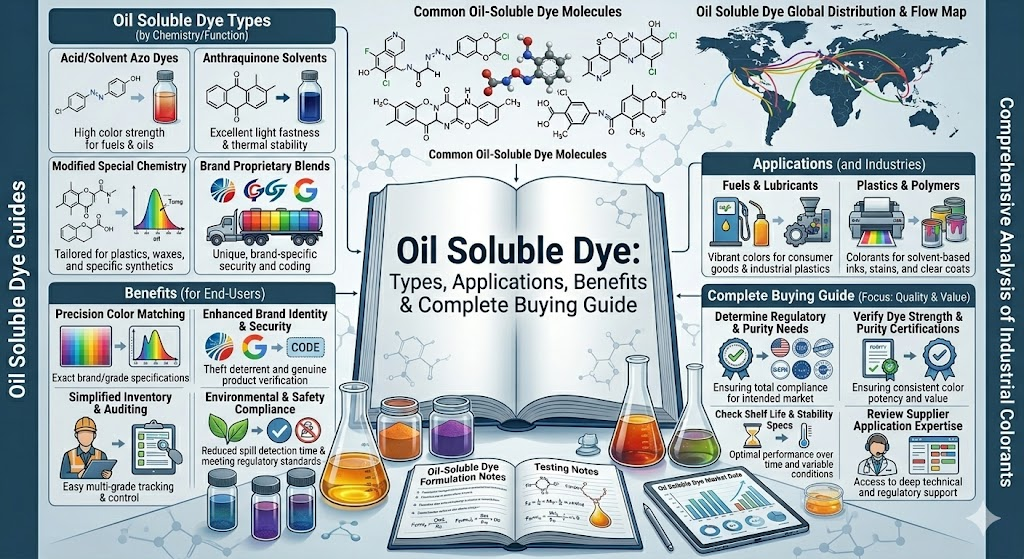
Whenever you see coloured fuel flowing through a refinery pipeline, a vibrant red transmission fluid being poured into an engine, or a perfectly tinted candle glowing on a dinner table, there is an Oil Soluble Dye doing its job. These are a family of colourants specifically designed to dissolve in oils, fuels, waxes, and other non-aqueous, hydrocarbon-based products — delivering vivid, transparent colour without altering the host product’s performance.
In this guide, we will explain what Oil Soluble Dye is, how it works, the different types available, where it is used across industries, and what to look for when sourcing it. Whether you are formulating lubricants, colouring fuels, manufacturing candles, or developing oil-based inks, this article gives you the practical knowledge you need.
What Is Oil Soluble Dye?
An Oil Soluble Dye is a colourant that dissolves at the molecular level in non-polar media — hydrocarbon solvents, mineral oils, vegetable oils, petroleum fuels, waxes, fats, and greases. Unlike water-soluble dyes (which dissolve in aqueous systems) or pigments (which are insoluble particles that require dispersion), oil soluble dyes form true solutions in their host medium, producing transparent, homogeneous colour.
In chemical classification terms, most oil soluble dyes belong to the “solvent dye” family. The two terms — oil soluble dye and solvent dye — are used interchangeably across the industry. They describe the same class of colourants from two perspectives: one focuses on the practical property (oil solubility), the other on the chemical classification (solvent-based).
Modern oil soluble dyes are supplied as concentrated liquid solutions, pre-dissolved in high-flash hydrocarbon solvents, xylene, or toluene. This liquid-to-liquid format makes them ready for immediate use: measure the required volume, inject into the product, and the colour distributes instantly and uniformly.
Key Characteristics and Properties
What makes a good Oil Soluble Dye? Here are the properties that matter most in industrial applications:
Complete solubility: The dye must dissolve fully in the target medium without cloudiness, sediment, or precipitation — even at low temperatures.
Colour strength: High tinting power at low concentrations (ppm levels for fuels; percentage levels for inks and candles) keeps dosing costs minimal.
Chemical inertness: The dye must not react with the host product or alter its functional properties (combustion, viscosity, lubricity, etc.).
Thermal stability: For applications like plastics moulding (up to 300°C+) or engine lubricants, the dye must withstand high operating temperatures without degradation or colour shift.
Lightfastness: Resistance to fading under UV and visible light exposure, particularly important for candles, inks, and coatings.
No migration or bleeding: The dye should remain in the host medium without migrating into adjacent materials or staining packaging.
Types of Oil Soluble Dyes
Oil soluble dyes span several chemical families, each with distinct performance characteristics suited to different applications:
| Type | Chemical Class | Colours Available | Key Applications | Example Dyes |
| Azo Oil Soluble Dyes | Mono-azo / diazo | Red, Yellow, Orange | Fuel marking, gasoline/diesel colouring, wax | Solvent Red 164, Solvent Yellow 107, Solvent Orange 98 |
| Anthraquinone Oil Soluble Dyes | Anthraquinone | Blue, Green, Violet | Fuel grade ID, lubricant colouring, plastics | Solvent Blue 79, Solvent Blue 35, Solvent Green 33 |
| Metal-Complex Oil Soluble Dyes | Metal-complex azo | Black, Brown, Yellow, Red | Inks, wood stains, leather finishes, coatings | Solvent Black 27, Solvent Yellow 21, Solvent Red 8 |
| Fluorescent Oil Soluble Dyes | Various | Bright green, yellow, red | Leak detection, flow tracing, safety marking | Fluorescent Yellow, Fluorescent Red |
| Perinone / Quinophthalone Dyes | Perinone / quinophthalone | Yellow, Orange, Red | High-performance plastics, automotive coatings | Solvent Yellow 33, Solvent Red 135 |
For fuel and lubricant applications, azo and anthraquinone dyes are the workhorses. For inks and coatings, metal-complex dyes offer the best combination of colour strength and fastness. For plastics, thermal stability is the deciding factor, often favouring anthraquinone and perinone types.
Applications of Oil Soluble Dye Across Industries
Fuels and Petroleum Products
The single largest market for oil soluble dyes. Refineries and fuel distributors use them to colour-code gasoline, diesel, kerosene, aviation fuel, and heating oil for tax enforcement, grade differentiation, and anti-adulteration. Every coloured fuel you have ever seen — red off-road diesel, blue avgas, yellow kerosene — uses an oil soluble dye.
Lubricants and Industrial Oils
Transmission fluid (red), coolant (green or orange), hydraulic oil (blue or amber), gear oil — all use oil soluble dyes for product identification and brand differentiation. The dyes must withstand the thermal and chemical environment of working machinery.
Wax and Candle Manufacturing
Oil soluble dyes dissolve cleanly in paraffin, soy wax, and gel wax, producing bright, even colour without sediment or wick clogging. They are the preferred colourant type for premium candle production.
Printing Inks and Coatings
Oil-based and solvent-based inks for packaging, markers, ballpoint pens, and industrial coding rely heavily on metal-complex and azo oil soluble dyes. The dyes provide high tinting strength, fast dispersion, and good lightfastness.
Plastics and Polymers
Oil soluble dyes dissolve into polymer melts during extrusion or injection moulding, producing transparent, vivid colouring in polystyrene, acrylic, PET, nylon, polycarbonate, and ABS. Heat-stable anthraquinone and perinone types can withstand processing temperatures above 300°C.
Smoke Dyes and Pyrotechnics
Speciality oil soluble dyes are used in coloured smoke formulations for military signalling, airshow displays, rescue operations, and crowd management applications.
Oil Soluble Dye vs. Water-Based Dye: A Clear Comparison
| Factor | Oil Soluble Dye | Water-Based Dye |
| Solubility | Dissolves in oils, fuels, waxes, organic solvents | Dissolves in water and aqueous systems |
| Primary Industries | Petroleum, lubricants, plastics, inks, candles | Textiles, paper, food, cosmetics |
| Colour Transparency | Transparent in oil/hydrocarbon media | Transparent in aqueous media |
| Water Resistance | Excellent — insoluble in water | Poor — may bleed or wash out |
| Thermal Stability | Generally high (up to 300°C+ for some types) | Varies; often lower |
| Handling Form | Liquid concentrate or powder | Liquid or powder |
| Environmental Profile | Solvent-based; requires proper ventilation | Water-based; generally lower VOC |
| Typical Dosage | 5–20 ppm (fuels); 0.1–5% (inks, candles) | Varies by application |
The choice is simple: if your product is oil-based, hydrocarbon-based, or non-aqueous, you need an Oil Soluble Dye. If it is water-based, you need a water-soluble dye. Using the wrong type will result in poor dissolution, cloudiness, or complete incompatibility.
Advantages of Oil Soluble Dye
True dissolution: Forms a molecular solution, not a suspension — no settling, no sediment, no filter clogging.
Vivid, transparent colour: Produces bright, clear hues that let you see through the coloured product (critical for fuels and lubricants).
Chemically inert: No impact on fuel performance, lubricant viscosity, or plastic mechanical properties.
Wide compatibility: Works across an enormous range of non-polar media — from light gasoline to heavy gear oil to solid wax.
Economical: High tinting strength means very low dosing — a little goes a long way.
Liquid format safety: Modern liquid formulations eliminate dust hazards associated with older powder dyes.
Factors to Consider Before Buying Oil Soluble Dye
Application match: Different applications demand different dye types. Fuels need azo or anthraquinone dyes; plastics need heat-stable types; inks may need metal-complex dyes. Start with the application.
Solubility in your specific product: Not all oil soluble dyes perform equally in all oils. Test compatibility with your specific base oil, fuel, or wax before committing to bulk purchase.
Regulatory compliance: For fuel applications, the dye must meet the colour and concentration requirements of your market’s regulations.
Zero insolubles: Impurities clog filters, injectors, and dosing equipment. Insist on impurity-free formulations.
Batch consistency: Every batch should deliver identical colour strength. Request certificates of analysis.
ISO certification: ISO 9001:2015, ISO 14001:2015, and ISO 45001:2018 certifications indicate quality, environmental, and safety management.
Storage and Handling Guidelines
Store oil soluble dyes in their original sealed containers, in a cool and dry area between 5°C and 40°C, away from direct sunlight and heat sources. For solvent-based liquid formulations, ensure storage areas comply with flammable-liquid safety regulations. Wear gloves, eye protection, and appropriate clothing when handling. Avoid inhalation of vapours and ensure adequate ventilation. Always consult the manufacturer’s Safety Data Sheet (SDS) for product-specific guidelines. Under proper conditions, shelf life is typically 1–2 years from manufacture.
Case Study: Standardising Lubricant Colour Across a Global Brand
Background: A multinational lubricant manufacturer producing transmission fluid, gear oil, and hydraulic fluid across four blending plants in Asia, the Middle East, and Africa was receiving persistent complaints from distributors that the same product looked different depending on which plant produced it. The company’s signature red transmission fluid, for example, ranged from pale pink to deep crimson across plants.
The Problem: Each plant was independently sourcing Oil Soluble Dye from local suppliers, resulting in significant colour variation between batches and plants. Distributors and end-users were questioning product authenticity, and the inconsistency was undermining the brand’s premium positioning. Two major automotive OEM clients raised formal quality concerns.
The Solution: The manufacturer consolidated all Oil Soluble Dye procurement to a single ISO-certified supplier capable of delivering identical liquid dye formulations to all four plants worldwide. The chosen supplier provided a custom red dye blend (azo-based, in high-flash solvent base) with spectrophotometric colour-matching to an agreed master standard, backed by certificates of analysis for every batch.
Results:
| Metric | Before (Multiple Local Suppliers) | After (Single Global Supplier) |
| Colour Consistency (ΔE* deviation) | 6.5–9.2 (visible difference) | 0.8–1.2 (imperceptible) |
| Distributor Colour Complaints | ~30 per quarter | 0 |
| OEM Quality Escalations | 2 in 12 months | 0 |
| Dye Supplier Count | 7 across 4 plants | 1 globally |
| Time to Match New Shade Requests | 4–6 weeks | 5–7 working days |
| Annual Dye Procurement Cost | Baseline | ~9% reduction (volume pricing) |
Key Takeaway: Colour is brand identity in the lubricant industry. By consolidating to a single, quality-assured Oil Soluble Dye supplier, the manufacturer eliminated the variation that was eroding distributor confidence and OEM trust — while also reducing procurement costs. The case underscores a universal truth: consistency of supply is as important as the dye itself.
Choosing a Trusted Oil Soluble Dye Manufacturer
Anar Chemicals LLP is an established oil soluble dye manufacturer based in India, ISO 9001:2015, ISO 14001:2015 & ISO 45001:2018 certified, with over four decades of experience. Their Liquid Petroleum or Fuel Dyes range includes azo, anthraquinone, and custom-blend oil soluble dyes in red, yellow, blue, green, orange, and bespoke shades. They also manufacture candle dyes and smoke dyes using the same oil-soluble technology. Explore their Products page or contact them directly for bulk and custom requirements.
Frequently Asked Questions About Oil Soluble Dye
Q: What is Oil Soluble Dye used for?
Oil Soluble Dye is used to colour non-aqueous products such as fuels, lubricants, hydraulic oils, waxes, candles, plastics, printing inks, and coatings. It dissolves directly in hydrocarbon and oil-based media, providing vivid, transparent colour without affecting the product’s functional properties.
Q: Are oil soluble dyes safe?
Yes. At the concentrations used in industrial applications (typically 5–20 ppm for fuels, up to 5% for inks), oil soluble dyes are chemically inert in the host product. Liquid formulations eliminate airborne dust hazards associated with powder dyes. Standard chemical handling precautions (gloves, eye protection, ventilation) apply.
Q: How do oil soluble dyes work in fuels?
Oil soluble dyes dissolve at the molecular level in hydrocarbon fuels, producing a clear, homogeneous colour throughout the product. They do not form suspensions or sediments. The dye molecules remain in solution during storage, transport, and combustion, without affecting fuel performance.
Q: What is the difference between solvent dyes and oil soluble dyes?
They are essentially the same thing described from two perspectives. “Solvent dye” refers to the chemical classification (dyes soluble in organic solvents). “Oil soluble dye” describes the practical property (dyes that dissolve in oils and hydrocarbons). Most oil soluble dyes are solvent dyes by classification. The terms are used interchangeably in the industry.
Q: Can oil soluble dyes be used in food or cosmetics?
Only specific food-grade and cosmetic-grade oil soluble dyes that have been approved by regulatory bodies (such as FDA in the US or FSSAI in India) can be used in food or cosmetics. Industrial oil soluble dyes used for fuels, plastics, and lubricants are not suitable for food or cosmetic applications.
Q: Where can I buy Oil Soluble Dye in India?
Oil Soluble Dye is available from speciality manufacturers such as Anar Chemicals LLP (anarchem.com), an ISO 9001:2015, ISO 14001:2015 & ISO 45001:2018 certified company with over 40 years of experience in petroleum dyes and speciality chemicals. They produce oil soluble dyes in red, yellow, blue, green, orange, and custom blends.
Q: How should oil soluble dyes be stored?
Store in tightly sealed, original containers in a cool, dry area between 5°C and 40°C, away from direct sunlight and heat sources. For solvent-based liquid formulations, ensure the storage area meets flammable-liquid safety requirements. Under proper conditions, shelf life is typically 1–2 years.