
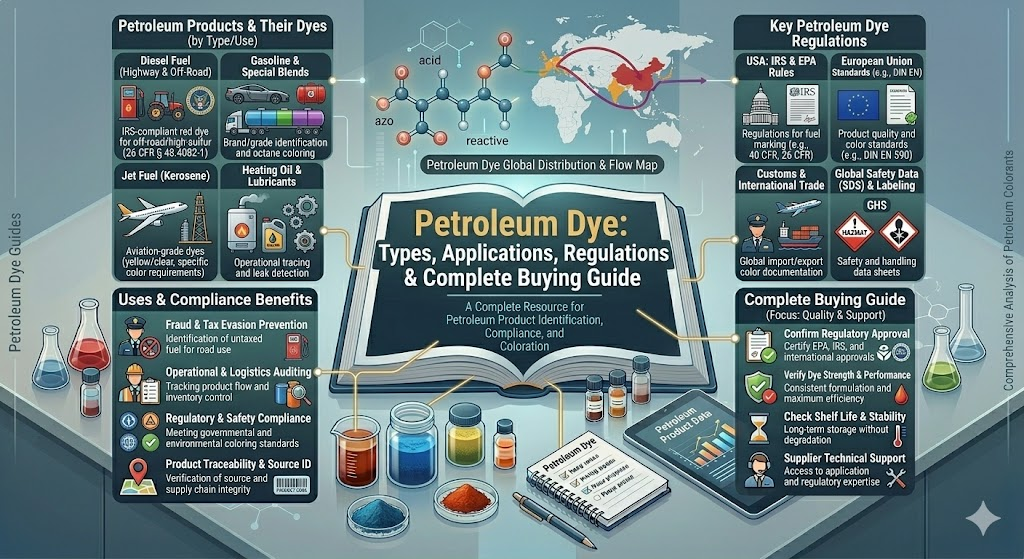
Walk into any fuel depot, refinery tank farm, or lubricant blending plant and you will notice something interesting: the products are coloured. Diesel might be red, gasoline yellow, kerosene blue, and transmission fluid a distinctive crimson. None of these colours occur naturally — they are all the work of Petroleum Dye, a category of oil-soluble colourants specifically designed for hydrocarbon-based products.
In this guide, we will explain what Petroleum Dye is, why it matters across the fuel and lubricant supply chain, the different types available, how it is regulated, and what to look for when sourcing it. Whether you are a refinery operator, a fuel distributor, a lubricant manufacturer, or a procurement specialist, this article gives you the practical knowledge you need.
What Is Petroleum Dye?
Petroleum Dye is a solvent-soluble colourant that dissolves completely in hydrocarbon-based products — fuels, lubricants, oils, waxes, and greases — without affecting their chemical composition or performance. These dyes belong to the solvent dye class (as opposed to water-soluble dyes) and are typically based on azo or anthraquinone chemical structures.
Modern petroleum dyes are supplied as concentrated liquid solutions, pre-dissolved in high-flash solvents or xylene, ready for direct injection into fuel or oil products. This liquid-to-liquid format replaced the older powder dye approach that dominated until the 1960s, and it offers significant advantages in safety, consistency, and operational efficiency.
At the concentrations used (typically 10–20 parts per million), Petroleum Dye is chemically inert. It does not alter combustion characteristics, octane or cetane ratings, viscosity, or any other functional property of the host product. Its sole purpose is to add colour.
Why Petroleum Products Are Dyed
1. Tax Enforcement and Fiscal Marking
This is the single largest application for Petroleum Dye worldwide. Governments use coloured dyes (most commonly red) to mark tax-exempt diesel and heating oil, allowing enforcement agencies to visually distinguish taxed on-road fuel from untaxed off-road fuel. In the United States, for example, the IRS mandates Solvent Red 164 in tax-exempt diesel under 26 CFR 48.4082-1.
2. Fuel Grade Differentiation
Refineries and distributors use different colours to distinguish fuel grades during storage, transportation, and dispensing. High-octane vs. low-octane gasoline, high-sulphur vs. low-sulphur diesel, aviation fuel vs. automotive fuel — colour-coding prevents costly and potentially dangerous mix-ups.
3. Anti-Adulteration and Quality Control
In markets like India, fuel adulteration (mixing cheaper products like kerosene into diesel) is a significant concern. Petroleum Dye helps identify adulterated fuel at the distribution and retail level by providing a visual quality marker.
4. Branding and Product Identity
Lubricant and speciality oil manufacturers use Petroleum Dye to give their products a distinctive, recognisable colour. Transmission fluid is typically red, coolant is green or orange, and hydraulic oil may be blue or amber. This colour identity helps end-users identify the right product at a glance and reinforces brand recognition.
5. Leak Detection
Fluorescent petroleum dyes are used in engine, hydraulic, and HVAC systems to detect leaks. The dye circulates with the fluid and concentrates at leak points, where it becomes visible under UV light. This is a quick, non-invasive diagnostic method widely used in automotive and industrial maintenance.
Types of Petroleum Dyes
Petroleum dyes can be categorised by their chemical class, colour, and intended function. Here is a comprehensive overview:
| Type | Chemical Class | Colours Available | Key Applications | Example Dyes |
| Azo Solvent Dyes | Diazo / mono-azo | Red, Yellow, Orange | Fuel marking, tax enforcement, grade ID | Solvent Red 164, Solvent Yellow 107, Solvent Orange 98 |
| Anthraquinone Solvent Dyes | Anthraquinone | Blue, Green, Violet | Fuel grade ID, lubricant colouring | Solvent Blue 79, Solvent Green 33 |
| Metal-Complex Solvent Dyes | Metal-complex azo | Black, Brown, custom | Inks, coatings, wood stains | Solvent Black 27, Solvent Brown 43 |
| Fluorescent Dyes | Various | Bright yellow, green, red | Leak detection, flow tracing | Fluorescent Yellow, Fluorescent Red |
| Fiscal Markers (Invisible) | Proprietary | Colourless / near-invisible | Tax fraud detection, forensic enforcement | ACCUTRACE Plus (EU), proprietary markers |
| Custom Blend Dyes | Mixed classes | Any custom shade | Country-specific regulations, corporate branding | Tailored formulations |
Dyed vs. Undyed Petroleum Products: What Is the Difference?
A common question. Here is a clear comparison:
| Factor | Dyed Petroleum Product | Undyed (Clear) Petroleum Product |
| Chemical Composition | Identical to undyed product | Standard petroleum product |
| Performance | No difference in combustion, viscosity, or efficiency | Baseline performance |
| Visual Appearance | Coloured (red, yellow, blue, green, etc.) | Clear, pale straw, or colourless |
| Tax/Regulatory Status | May indicate tax-exempt or specific-grade status | Typically fully taxed (on-road fuel) |
| Identification | Instantly identifiable by colour | Requires documentation for grade verification |
| Enforcement | Detectable via dip-test, spectrophotometry, GC-MS | No dye to detect |
| Cost of Dye Addition | Minimal (₹0.01–0.05 per litre at ppm dosage) | None |
| Anti-Adulteration Value | Colour change indicates dilution or mixing | No visual safeguard |
The key point: Petroleum Dye adds identification capability without altering the product itself. It is pure information, encoded as colour.
Regulatory Overview: Petroleum Dye Around the World
Every major fuel-producing and fuel-consuming country has some form of petroleum dye regulation. The details vary, but the principle is universal: use colour and/or chemical markers to prevent tax evasion, adulteration, and misuse. In the US, the IRS mandates Solvent Red 164 for tax-exempt diesel. The EU replaced Solvent Yellow 124 with ACCUTRACE Plus in January 2024 for enhanced tamper resistance. The UK uses red dye plus a fiscal marker for gas oil and kerosene. India mandates various colour codes for different fuel types across states. Canada uses a combination of red/purple dye and yellow markers.
For manufacturers and suppliers of Petroleum Dye, staying current with these evolving regulations is critical — and it is one of the reasons why choosing an experienced, well-informed supplier matters.
Advantages of Using Petroleum Dye
Instant visual identification: Colour tells you what the product is, at a glance, without laboratory testing.
Tax revenue protection: Dye-based enforcement programmes protect billions in government tax revenue annually.
Safety through grade separation: Colour-coding prevents dangerous fuel mix-ups in storage and transport.
Brand differentiation: Distinctive colours help lubricant and oil brands stand out and build consumer trust.
Cost-effective: At ppm-level dosing, the per-litre cost of adding Petroleum Dye is negligible compared to the value it delivers.
No performance trade-off: Chemically inert; zero impact on the host product’s functional properties.
Factors to Consider Before Buying Petroleum Dye
Regulatory match: Ensure the dye meets the specific regulations of your target market (e.g., Solvent Red 164 for US tax-exempt diesel, specific colour codes for India).
Complete miscibility: The dye must dissolve fully in the petroleum product without cloudiness, sediment, or phase separation — even at low temperatures.
Zero insolubles: Insoluble particles clog dosing pumps, injection lines, and fuel filters. Insist on impurity-free formulations from every batch.
Batch-to-batch consistency: Colour strength must be uniform across production runs. Ask for certificates of analysis with spectrophotometric data.
Solvent base flexibility: Depending on your process, you may need dyes in high-flash, xylene, or toluene solvent bases. A versatile manufacturer offers all options.
ISO certification: Look for ISO 9001:2015, ISO 14001:2015, and ISO 45001:2018 as markers of quality, environmental, and safety management.
Custom blending: Many markets require non-standard colours. An experienced manufacturer can match any shade requirement.
Case Study: How a Multi-State Fuel Distributor Standardised Colour Across 15 Depots
Background: A large fuel distribution company operating 15 depots across central and western India was supplying diesel, kerosene, and gasoline to both retail outlets and industrial clients. Each depot was independently sourcing Petroleum Dye from local suppliers, resulting in visible colour differences between the same fuel grade across different locations.
The Problem: Retail outlet owners began complaining that diesel delivered from different depots “looked different” — some batches had a deep red tint, others were barely tinted. This triggered consumer trust issues and led to multiple adulteration complaints filed with the district supply office, even though the fuel itself was perfectly compliant. Two depots were also flagged during a state-level quality audit for dye concentrations outside the permitted range.
The Solution: The distributor consolidated all Petroleum Dye procurement to a single ISO-certified manufacturer, switching from powder dyes to pre-formulated liquid dyes in high-flash solvent base. Each colour (red for diesel, yellow for kerosene) was delivered at a standardised concentration, with automated proportional dosing pumps installed at every depot.
Results:
| Metric | Before (Multiple Suppliers, Powder) | After (Single Supplier, Liquid) |
| Colour Consistency Across Depots | Significant variation | Uniform across all 15 depots |
| Consumer Adulteration Complaints | 12 in 6 months | 0 in 12 months |
| Regulatory Audit Flags | 2 depots flagged | 0 across all depots |
| Dye Supplier Count | 7 local suppliers | 1 ISO-certified manufacturer |
| Dye Dissolution Time | 30–45 min per batch | Instant (pre-dissolved) |
| Annual Dye Procurement Cost | Baseline | ~11% reduction (volume pricing) |
| Worker Safety Incidents (Dye-Related) | 4 per year | 0 |
Key Takeaway: The single biggest improvement was not cost — it was consistency. By standardising on one quality-assured Petroleum Dye supplier, the distributor eliminated the colour variation that had been undermining consumer confidence and triggering regulatory scrutiny. The lesson applies universally: in petroleum dye, consistency is everything.
Choosing a Trusted Petroleum Dye Manufacturer
Anar Chemicals LLP is an established petroleum dye manufacturer based in India, ISO 9001:2015, ISO 14001:2015 & ISO 45001:2018 certified, with over four decades of experience. Their Liquid Petroleum or Fuel Dyes range includes Solvent Red 164, Solvent Yellow 107, Solvent Blue 79, Solvent Green 33, Solvent Orange 98, and a comprehensive library of custom-blend solvent dye mixtures. They also produce candle dyes and smoke dyes using the same oil-soluble dye technology. Explore their Products page or contact them directly for bulk and custom enquiries.
Frequently Asked Questions About Petroleum Dye
Q: What is Petroleum Dye used for?
Petroleum Dye is used to colour fuels, lubricants, and other petroleum products for identification, tax enforcement, grade differentiation, anti-adulteration, branding, and leak detection. It dissolves completely in hydrocarbon products without affecting their chemical or combustion properties.
Q: Why are fuels coloured differently?
Fuels are coloured differently to distinguish between grades (e.g., high-octane vs. low-octane gasoline), tax categories (taxed on-road vs. tax-exempt off-road diesel), and product types (kerosene vs. gas oil vs. aviation fuel). This colour-coding prevents dangerous mix-ups and supports regulatory enforcement.
Q: Are petroleum dyes safe?
Yes. Petroleum dyes are chemically inert at the concentrations used (typically 10–20 ppm) and do not alter fuel performance, combustion characteristics, or engine operation. Liquid formulations are safer to handle than powder dyes because they eliminate airborne dust. Standard chemical safety precautions (gloves, eye protection, ventilation) should be followed during handling.
Q: How are fuel dyes detected?
Fuel dyes are detected through visual inspection (for visible-colour dyes), dip-tests at roadside checkpoints, portable spectrophotometry, and laboratory-grade gas chromatography-mass spectrometry (GC-MS) for invisible markers. Modern methods can detect dye residues at parts-per-billion levels.
Q: What is the difference between a dye and a marker in petroleum?
A dye adds visible colour to the fuel (e.g., red for off-road diesel). A marker is a chemical additive that may be colourless or near-invisible but is detectable through chemical testing. Some fuel programmes use both: a visible dye for quick identification and an invisible marker for forensic-level enforcement.
Q: Where can I buy Petroleum Dye in India?
Petroleum Dye is available from speciality manufacturers such as Anar Chemicals LLP (anarchem.com), an ISO 9001:2015, ISO 14001:2015 & ISO 45001:2018 certified company with over four decades of experience in petroleum dyes and speciality chemicals. They offer a full range of red, yellow, blue, green, orange, and custom-blend petroleum dyes.
Q: Can petroleum dyes be custom-blended?
Yes. Experienced manufacturers can blend dyes to achieve specific shades, concentrations, and solvent bases required by country-specific regulations or corporate branding standards. Anar Chemicals offers custom shade matching and bespoke formulations for petroleum clients worldwide.