
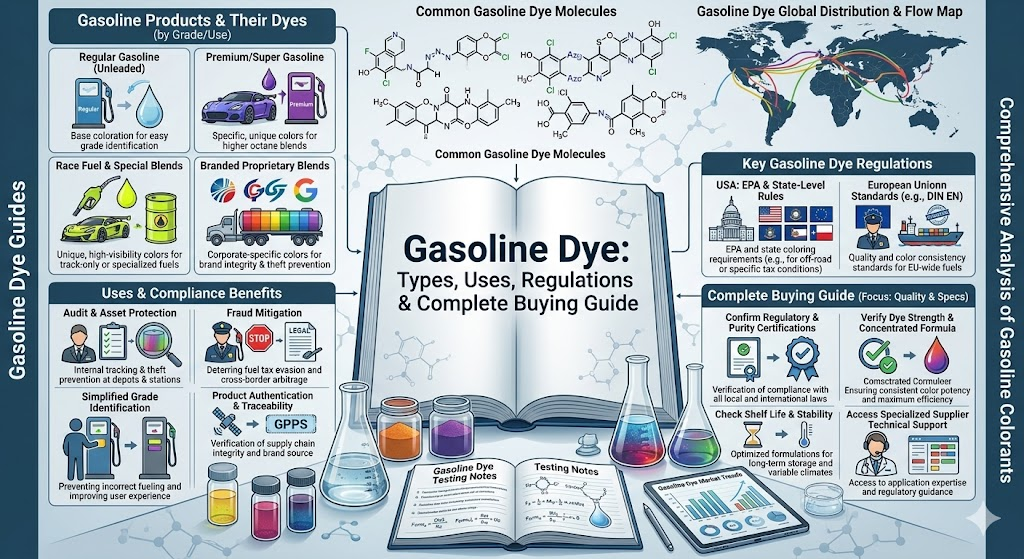
Next time you are at a petrol station, spare a thought for the unsung chemistry happening inside the fuel you are pumping. That slight tint of colour in your gasoline? It is not an accident — it is the work of a Gasoline Dye, a speciality solvent-soluble colourant added at the refinery to tell the world exactly what kind of fuel it is, where it should go, and how it should be taxed.
In this guide, we will cover everything you need to know about Gasoline Dye: what it is, why it is added, the types available, where it is used, how it is regulated around the world, and what to consider when sourcing it. Whether you are a refinery operator, a fuel distributor, or a procurement specialist, this article is for you.
What Is Gasoline Dye?
Gasoline Dye is an oil-soluble colourant that dissolves completely in gasoline (petrol) and other light hydrocarbon fuels to give them a distinctive colour. These dyes belong to the solvent dye family — typically azo or anthraquinone compounds with long alkyl side chains that ensure excellent solubility in non-polar media.
At typical dosing levels of 5 to 20 parts per million, Gasoline Dye is chemically inert. It does not alter the fuel’s octane rating, combustion characteristics, volatility, or engine performance. It simply adds a visual marker that carries significant regulatory, safety, and commercial meaning.
Modern gasoline dyes are supplied as concentrated liquid solutions in high-flash or xylene solvent bases, ready for direct injection into the fuel stream at refineries or terminals. This liquid format replaced older powder dyes and offers major advantages in safety, consistency, and automation.
Why Gasoline Is Dyed
1. Octane Grade Differentiation
This is one of the most practical applications of Gasoline Dye. Refineries and distributors use different colours to distinguish between regular, mid-grade, and premium gasoline during storage, pipeline transport, and dispensing. When millions of litres flow through shared infrastructure, colour-coding is a critical safeguard against mix-ups that could damage engines or void warranties.
2. Aviation Fuel Safety
Aviation gasoline (avgas) uses a mandatory, internationally standardised colour system. 100LL (low-lead) avgas is dyed blue, 100/130 grade is green, and 80/87 grade is red. This colour-coding exists for one reason: safety. Fuelling an aircraft with the wrong grade can cause engine failure in flight. The colour is the first and most visible safeguard against this catastrophic scenario.
3. Tax Enforcement and Fiscal Marking
In many countries, specific gasoline grades or applications carry different tax rates. Gasoline Dye allows enforcement agencies to visually confirm whether fuel has been properly taxed. In some markets, untaxed or subsidised gasoline is dyed a specific colour to prevent it from being resold at the taxed price.
4. Anti-Adulteration
In markets where fuel adulteration is a concern — such as mixing cheaper naphtha or solvent into gasoline — Gasoline Dye provides a visual quality check. If the colour changes, dilutes, or disappears, it is an immediate signal that the product has been tampered with.
5. Branding and Product Identity
Some fuel marketers use proprietary colours for their premium or branded fuel lines. A distinctive colour reinforces brand identity at the retail level and helps consumers associate visual cues with quality.
Types of Gasoline Dyes
Gasoline dyes can be categorised by chemical class, colour, and function:
| Type | Chemical Class | Colours | Key Applications | Example Dyes |
| Azo Solvent Dyes | Diazo / mono-azo | Red, Yellow, Orange | Octane grade ID, tax marking, anti-adulteration | Solvent Red 19, Solvent Red 164, Solvent Yellow 107 |
| Anthraquinone Solvent Dyes | Anthraquinone | Blue, Green, Violet | Aviation gasoline, grade differentiation | Solvent Blue 79, Solvent Blue 35, Solvent Green 33 |
| Blend / Mixture Dyes | Mixed azo + anthraquinone | Green, Bronze, Brown, custom | Custom grade ID, proprietary branding | Solvent Green 33, custom blends |
| Fluorescent Dyes | Various | Bright yellow, green | Leak detection, flow tracing | Fluorescent Yellow, Fluorescent Green |
| Fiscal Markers (Invisible) | Proprietary | Colourless | Tax fraud detection, forensic enforcement | ACCUTRACE Plus, proprietary markers |
For most gasoline applications, azo-based dyes in red and yellow dominate. Anthraquinone-based blue dyes are critical for aviation gasoline. Green dyes (blends of blue and yellow) serve specific country regulations. And invisible markers add a forensic layer that complements visible colour.
Dyed Gasoline vs. Undyed Gasoline: What Is the Difference?
| Factor | Dyed Gasoline | Undyed (Clear) Gasoline |
| Chemical Composition | Identical base fuel | Identical base fuel |
| Octane Rating | Unchanged | Unchanged |
| Engine Performance | No difference | Baseline |
| Visual Appearance | Tinted (red, yellow, blue, green, etc.) | Clear or pale straw |
| Identification | Instantly identifiable by colour | Requires documentation or testing |
| Tax/Grade Status | May indicate specific grade, tax category, or use restriction | Default taxed automotive fuel |
| Anti-Adulteration | Colour change signals tampering | No visual safeguard |
| Cost of Dye | Negligible (fractions of a paisa per litre at ppm dosing) | None |
The takeaway: adding Gasoline Dye costs virtually nothing per litre but delivers enormous value in identification, safety, compliance, and fraud prevention.
Regulatory Overview: Gasoline Dye Around the World
Gasoline dye regulations vary by country, but the underlying principle is consistent: use colour to prevent misuse, ensure safety, and protect tax revenue.
| Country/Region | Application | Colour | Key Regulation/Standard |
| United States | Aviation gasoline grade ID | Blue (100LL), Green (100/130), Red (80/87) | ASTM D910; FAA regulations |
| United States | Tax-exempt fuel marking | Red | IRS 26 CFR 48.4082-1 |
| European Union | Fiscal fuel marking | Near-invisible marker | EU Decision 2022/197 (ACCUTRACE Plus) |
| United Kingdom | Rebated gas oil and kerosene | Red + fiscal marker | Hydrocarbon Oil (Marking) Regulations 2002 |
| India | Fuel grade differentiation | Various (red, yellow, blue) | Country-specific petroleum ministry guidelines |
| Canada | Tax-exempt fuel | Red/purple + yellow marker | Provincial regulations |
For manufacturers and suppliers, understanding these regulations is essential. A Gasoline Dye that works perfectly in one market may not meet the requirements of another. This is why choosing a manufacturer with global regulatory knowledge matters.
Advantages of Using Gasoline Dye
Instant identification: Colour tells operators, distributors, and inspectors what the fuel is, without lab testing.
Safety in aviation: The avgas colour-coding system is a life-saving standard that prevents misfuelling.
Tax compliance: Dye-based programmes protect government revenue and deter fraud.
Anti-adulteration: Colour changes signal product tampering immediately.
Negligible cost: At ppm dosing, the cost per litre of dyed fuel is effectively zero.
No performance impact: Chemically inert; zero effect on octane, combustion, or engine longevity.
Factors to Consider Before Buying Gasoline Dye
Regulatory match: The dye must comply with the specific colour and concentration requirements of your target market. Aviation dyes follow ASTM D910; road fuel dyes follow IRS or local petroleum authority guidelines.
Gasoline compatibility: Gasoline is a lighter, more volatile product than diesel. The dye must be fully soluble in light hydrocarbons without any precipitation, even in low-temperature storage.
Colour stability: The dye should maintain consistent colour intensity over the fuel’s storage life. Fading or colour shift can cause compliance issues and consumer complaints.
Zero insolubles: Insoluble particles can block fuel injectors and filters. Insist on impurity-free liquid formulations.
Batch consistency: Every production batch should deliver identical colour strength. Request certificates of analysis with spectrophotometric data.
ISO certification: ISO 9001:2015, ISO 14001:2015, and ISO 45001:2018 signal a manufacturer’s commitment to quality, environment, and safety.
Custom blending: Some markets and brands require proprietary colours. A capable manufacturer can match any shade.
Case Study: How a National Fuel Marketer Used Gasoline Dye to Differentiate Its Premium Brand
Background: A national fuel marketing company operating over 800 retail outlets across South Asia wanted to launch a premium high-octane gasoline brand to compete in the growing premium fuel segment. The fuel itself was a 95-octane formulation with additive packages, but the challenge was making it visually distinct from the company’s standard 87-octane product at the pump.
The Problem: Both the standard and premium fuels were clear, pale-straw-coloured liquids. Without a visual differentiator, consumers had no way to confirm they were receiving the premium product they paid extra for. Early market research showed that 68% of surveyed customers felt “unsure” whether the premium fuel they purchased was actually different from regular gasoline. This perception gap was undermining the premium’s price point and brand value.
The Solution: The company partnered with an ISO-certified Gasoline Dye manufacturer to develop a proprietary amber-gold colour for the premium fuel. The dye was a custom blend of Solvent Yellow 107 and a trace of Solvent Orange 98, formulated in a high-flash solvent base for direct injection at the company’s blending terminals. The standard-grade gasoline remained clear, creating an immediate visual contrast.
Results:
| Metric | Before (No Visual Differentiation) | After (Gasoline Dye Branding) |
| Consumer Confidence in Premium Product | 32% “fully confident” | 89% “fully confident” |
| Premium Fuel Sales Volume (Monthly) | Baseline | +27% increase within 6 months |
| Customer Complaints (“Is this really premium?”) | ~45 per month | <3 per month |
| Brand Recognition (Aided Recall) | Low | Ranked #2 in category within 12 months |
| Cost of Dye Per Litre | N/A | ₹0.02 per litre |
| Adulteration Complaints at Retail | Occasional | Eliminated (colour tamper-evidence) |
Key Takeaway: A colour change costing two paise per litre unlocked a 27% increase in premium fuel sales and transformed consumer confidence. This case demonstrates that Gasoline Dye is not just a compliance tool — it is a powerful branding and commercial instrument when used strategically.
Choosing a Trusted Gasoline Dye Manufacturer
Anar Chemicals LLP is an established gasoline dye manufacturer based in India, ISO 9001:2015, ISO 14001:2015 & ISO 45001:2018 certified, with over four decades of experience in petroleum dyes and speciality chemicals. Their Liquid Petroleum or Fuel Dyes range covers red, yellow, blue, green, orange, and custom-blend solvent dyes for gasoline, diesel, kerosene, and lubricants — all available in high-flash and xylene solvent bases. Explore their Products page or contact them directly for bulk and custom requirements.
Frequently Asked Questions About Gasoline Dye
Q: What is Gasoline Dye used for?
Gasoline Dye is used to colour gasoline (petrol) for identification, grade differentiation, tax enforcement, anti-adulteration, and branding purposes. It dissolves completely in the fuel without affecting octane rating, combustion, or engine performance.
Q: Why is petrol coloured differently?
Petrol is coloured differently to distinguish between octane grades (regular vs. premium vs. super), to mark tax-exempt or subsidised fuel, to prevent adulteration or mixing errors, and in some cases for aviation safety (to prevent misfuelling aircraft). Each colour serves as a visual code recognised across the supply chain.
Q: Are gasoline dyes safe?
Yes. Gasoline dyes are chemically inert at the concentrations used (typically 5–20 ppm). They do not affect fuel quality, engine performance, or emissions. Liquid formulations are safer to handle than powder dyes since they eliminate airborne dust. Standard chemical safety precautions apply during handling.
Q: How are fuel dyes in gasoline detected?
Fuel dyes in gasoline are detected through visual inspection, dip-testing with absorbent paper, portable spectrophotometry, and laboratory GC-MS analysis. Even trace residues from past fills can be identified, making enforcement highly effective.
Q: What dyes are used in aviation gasoline?
Aviation gasoline (avgas) uses a specific colour-coding system for safety: 100LL (low-lead) is dyed blue, 100/130 grade is green, and 80/87 grade is red. These colours prevent dangerous misfuelling and are mandated by aviation authorities worldwide.
Q: Where can I buy Gasoline Dye in India?
Gasoline Dye is available from speciality petroleum dye manufacturers such as Anar Chemicals LLP (anarchem.com), an ISO 9001:2015, ISO 14001:2015 & ISO 45001:2018 certified company with over 40 years of experience. They produce a full range of solvent dyes for gasoline in multiple colours and solvent bases.
Q: Does Gasoline Dye affect fuel economy or engine life?
No. At the ppm concentrations used, Gasoline Dye has zero measurable impact on fuel economy, octane rating, combustion efficiency, or engine longevity. The dye is purely a visual marker.