
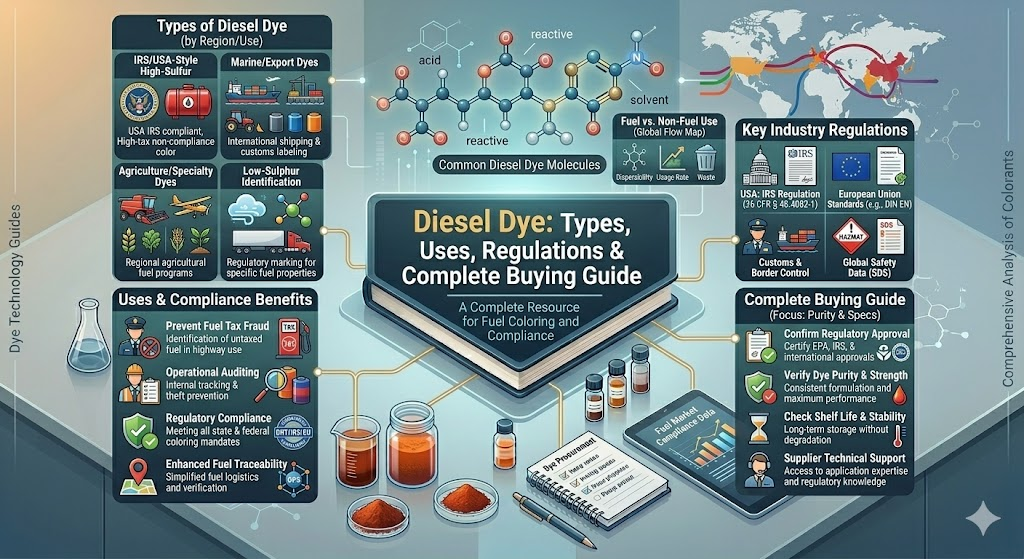
Every time you see a piece of farm equipment rumbling across a field or a construction crane lifting steel beams on a building site, there is a good chance the fuel powering that machine has been coloured with a Diesel Dye. It is one of those behind-the-scenes details that most people never think about, but for governments, refineries, and fuel distributors worldwide, diesel dye is a critical compliance tool worth billions in tax revenue protection.
In this guide, we will cover everything you need to know about Diesel Dye: what it is, why governments mandate it, the different types available, how it is detected, and what to look for when sourcing it. Whether you are a fuel distributor, a refinery operations manager, or a procurement specialist exploring dye suppliers, this article is written for you.
What Is Diesel Dye?
Diesel Dye is a solvent-soluble colourant added to diesel fuel in very small concentrations (typically 10–20 parts per million) to visually mark it for identification purposes. The dye dissolves completely in the fuel without affecting its chemical composition, combustion performance, or engine operation. It simply adds colour — and that colour carries enormous legal and regulatory significance.
The most widely recognised example is red diesel dye, which marks tax-exempt, off-road diesel fuel in countries like the United States, United Kingdom, Canada, and India. But diesel dyes come in many colours — red, yellow, blue, green, orange, and custom blends — depending on the country’s regulations and the specific fuel grade being identified.
Why Diesel Fuel Is Dyed
The primary reason is tax enforcement. Governments impose excise taxes on diesel used for on-road vehicles to fund highway infrastructure. Diesel used for off-road purposes — agriculture, construction, heating, mining, marine — is often tax-exempt or taxed at a lower rate. Without a visible marker, there would be no practical way to distinguish taxed fuel from untaxed fuel during enforcement inspections.
Diesel Dye solves this problem elegantly. A tiny amount of dye is added at the refinery or terminal, and the fuel is instantly and permanently marked. Enforcement officers can then test fuel tanks using simple dip-tests or portable spectrometers to check whether a vehicle is using properly taxed fuel.
Beyond tax enforcement, diesel dyes also serve to colour-code different fuel grades, prevent adulteration and cross-contamination during storage and transport, and help identify fuel theft or diversion.
Types of Diesel Dyes
Diesel dyes fall into two broad categories: visual dyes (which add visible colour) and marker dyes (which may be invisible but detectable through chemical testing). Here is a detailed breakdown:
| Type of Diesel Dye | Chemical Class | Colour | Primary Use | Example Dyes |
| Red Fuel Dye | Azo (diazo) | Red | Tax-exempt off-road diesel marking | Solvent Red 164, Solvent Red 26, Solvent Red 19 |
| Yellow Fuel Dye | Azo (diazo) | Yellow | Fuel grade differentiation, gasoline marking | Solvent Yellow 107, Solvent Yellow 124 |
| Blue Fuel Dye | Anthraquinone | Blue | Grade differentiation, government/institutional fuel | Solvent Blue 79, Solvent Blue 35 |
| Green Fuel Dye | Blend (blue + yellow) | Green | Specific country regulations, grade identification | Solvent Green 33, custom blends |
| Orange Fuel Dye | Azo | Orange | Specific country regulations | Solvent Orange 98 |
| Fiscal Marker (Invisible) | Proprietary | Colourless | Tax fraud detection (EU Euromarker, ACCUTRACE Plus) | ACCUTRACE Plus (replaced Solvent Yellow 124 in EU) |
How Diesel Dye Is Detected
Detection methods range from simple visual inspection to advanced spectrographic analysis. Enforcement officers typically use a probe or syringe to draw a fuel sample from the vehicle’s tank. If the sample shows visible red colour, the vehicle is flagged. For more sophisticated detection, portable spectrophotometers can identify dye concentrations as low as parts-per-billion — meaning even a single past tank of dyed diesel used months ago may still be traceable.
In the EU, the new ACCUTRACE Plus marker (which replaced Solvent Yellow 124 in January 2024) is specifically designed to resist “laundering” attempts and can be detected using gas chromatography-mass spectrometry (GC-MS) at extremely low levels.
Regulatory Overview: Diesel Dye Around the World
| Country/Region | Dye Colour | Key Regulation | Dye Used |
| United States | Red | IRS 26 CFR 48.4082-1; EPA 40 CFR 80.29 | Solvent Red 164 (spectral equiv. to SR 26) |
| United Kingdom | Red + Marker | Hydrocarbon Oil (Marking) Regulations 2002 | Solvent Red 24 + ACCUTRACE Plus |
| European Union | Marker (near-invisible) | EU Implementing Decision 2022/197 | ACCUTRACE Plus (replaced SY 124) |
| Canada | Red/Purple + Yellow marker | Federal/provincial regulations | Red dye + Solvent Yellow 124 |
| India | Various (red, yellow, blue) | Country-specific fuel colour-coding regulations | Solvent Red 164, Solvent Yellow 107, Solvent Blue 79 |
Dyed Diesel vs. Clear Diesel: What Is the Difference?
This is one of the most common questions. Here is a straightforward comparison:
| Factor | Dyed (Red) Diesel | Clear (Undyed) Diesel |
| Chemical Composition | Ultra-low sulphur diesel (ULSD) | Ultra-low sulphur diesel (ULSD) |
| Performance | Identical combustion, power, efficiency | Identical combustion, power, efficiency |
| Tax Status | Tax-exempt (off-road use) | Fully taxed (on-road use) |
| Price | Lower (no excise tax) | Higher (includes excise tax) |
| Legal Use | Off-road only: agriculture, construction, heating, marine | All vehicles on public roads |
| Visual Identification | Red tint visible in fuel | Clear or pale straw colour |
| Enforcement | Dip-test and spectrographic analysis | N/A (no marking to detect) |
| Penalty for Misuse | $1,000+ fines, back taxes, criminal charges (US) | N/A |
The critical takeaway: there is zero performance difference. The only distinction is legal and financial — and that distinction carries serious consequences if violated.
Advantages of Using Diesel Dye
Tax revenue protection: Governments recover hundreds of millions in excise tax revenue annually through dyed fuel enforcement programmes.
Fraud deterrence: The persistence and detectability of modern diesel dyes make fuel laundering and tax evasion increasingly difficult.
Fuel grade identification: Colour-coding different fuel grades at refineries and depots prevents costly cross-contamination and mix-ups.
Anti-adulteration: In markets like India, diesel dyes help identify adulterated or diluted fuel at the distribution level.
No performance impact: At ppm-level concentrations, Diesel Dye is chemically inert and does not affect fuel quality or engine life.
Factors to Consider Before Buying Diesel Dye
Regulatory compliance: Ensure the dye meets the specific regulations of your target market. For the US, this means Solvent Red 164 at the spectral equivalency mandated by the IRS. For India or other markets, check country-specific requirements.
Complete miscibility: The dye must dissolve fully in diesel without cloudiness, sediment, or phase separation — even at low temperatures.
Zero insolubles: Insoluble particles can clog injection systems and dosing equipment. Insist on impurity-free formulations.
Batch consistency: Every production batch should deliver the same colour strength. Ask for certificates of analysis.
ISO certification: Manufacturers with ISO 9001:2015, ISO 14001:2015, and ISO 45001:2018 demonstrate commitment to quality, safety, and environmental management.
Custom blending: Some markets require non-standard colours or specific shade intensities. Choose a manufacturer that offers custom blends.
Case Study: How a Fuel Distributor Achieved 100% Compliance with Diesel Dye
Background: A fuel distribution company operating 12 depots across western India was supplying both taxed on-road diesel and tax-exempt off-road diesel to clients in agriculture, construction, and mining. Their existing process involved adding Diesel Dye manually at each depot using powder-based dyes pre-dissolved in small batches.
The Problem: During a government audit, three depots were flagged for inconsistent dye concentrations in their off-road diesel. Some samples showed colour well below the required intensity, raising concerns about potential under-dyeing (which could enable fuel diversion). The manual dissolution process was also creating worker health complaints due to powder dust exposure, and colour variation between depots was undermining the company’s quality reputation.
The Solution: The distributor switched to a pre-formulated liquid Diesel Dye (Solvent Red 164 in high-flash solvent base) supplied by an ISO-certified manufacturer. The liquid formulation was injected directly into the fuel flow at each depot using proportional dosing pumps, calibrated to deliver a consistent 15 ppm concentration.
Results:
| Metric | Before (Powder Dye, Manual) | After (Liquid Diesel Dye, Automated) |
| Dye Concentration Consistency | ±35% variation across depots | ±3% variation |
| Government Audit Flags | 3 in 12 months | 0 in 18 months |
| Worker Dust Exposure Complaints | Regular | Eliminated |
| Dye Dissolution Time | 30–45 min per batch | Instant (pre-dissolved) |
| Annual Dye Wastage | ~15% | <3% |
| Depot Standardisation | Inconsistent across 12 sites | Uniform across all 12 sites |
Key Takeaway: The switch to a quality-assured liquid Diesel Dye eliminated the compliance gaps that had triggered government scrutiny, while simultaneously improving worker safety and reducing operational waste. Consistency of supply and product quality proved to be the decisive factors.
Choosing a Trusted Diesel Dye Manufacturer
Anar Chemicals LLP is an established diesel dye manufacturer based in India, ISO 9001:2015, ISO 14001:2015 & ISO 45001:2018 certified, with over four decades of experience in petroleum dyes and speciality chemicals. Their Liquid Petroleum or Fuel Dyes range includes Solvent Red 164, Solvent Yellow 107, Solvent Blue 79, Solvent Green 33, Solvent Orange 98, and custom dye blends — all available in high-flash and xylene solvent bases. Explore their full Products catalogue or get in touch for bulk and custom requirements.
Frequently Asked Questions About Diesel Dye
Q: What is Diesel Dye used for?
Diesel Dye is used to colour diesel fuel for identification and regulatory purposes. The most common use is marking tax-exempt (off-road) diesel with a red dye so enforcement agencies can visually distinguish it from taxed on-road fuel. Diesel dyes are also used to colour-code different fuel grades and prevent adulteration.
Q: Why is diesel coloured red?
Diesel is coloured red to indicate that it is tax-exempt and intended only for off-road use — such as agriculture, construction, heating, and industrial machinery. The red colour makes it immediately identifiable during enforcement inspections, deterring illegal use of cheaper untaxed fuel on public roads.
Q: Is dyed diesel legal?
Yes, dyed diesel is completely legal for its intended off-road uses. What is illegal is using red-dyed diesel in on-road vehicles, as this constitutes tax evasion. Penalties for misuse can reach $1,000 or $10 per gallon (whichever is greater) in the United States, plus back taxes and potential criminal charges.
Q: How is Diesel Dye detected?
Enforcement agencies use simple dip-tests and field spectrographic analysis to detect Diesel Dye in fuel tanks. Modern testing can identify even trace amounts of dye — meaning that using a single tank of dyed diesel months ago can still be detected during a roadside inspection.
Q: What is the difference between dyed diesel and clear diesel?
There is no chemical or performance difference. Both are ultra-low sulphur diesel (ULSD) with identical combustion characteristics. The only difference is the red dye added to mark fuel as tax-exempt. Clear (undyed) diesel carries highway excise taxes; dyed diesel does not.
Q: Where can I buy Diesel Dye in India?
Diesel Dye is available from speciality petroleum dye manufacturers such as Anar Chemicals LLP (anarchem.com), an ISO-certified company with over 40 years of experience producing liquid solvent dyes for fuel colouring. They offer red, yellow, blue, green, orange, and custom-blend diesel dyes in multiple solvent bases.
Q: Does Diesel Dye affect engine performance?
No. Diesel Dye is chemically inert at the concentrations used (typically 10–20 ppm). It does not alter combustion characteristics, cetane ratings, fuel efficiency, or engine longevity. The dye simply adds colour without changing the fuel’s functional properties.