
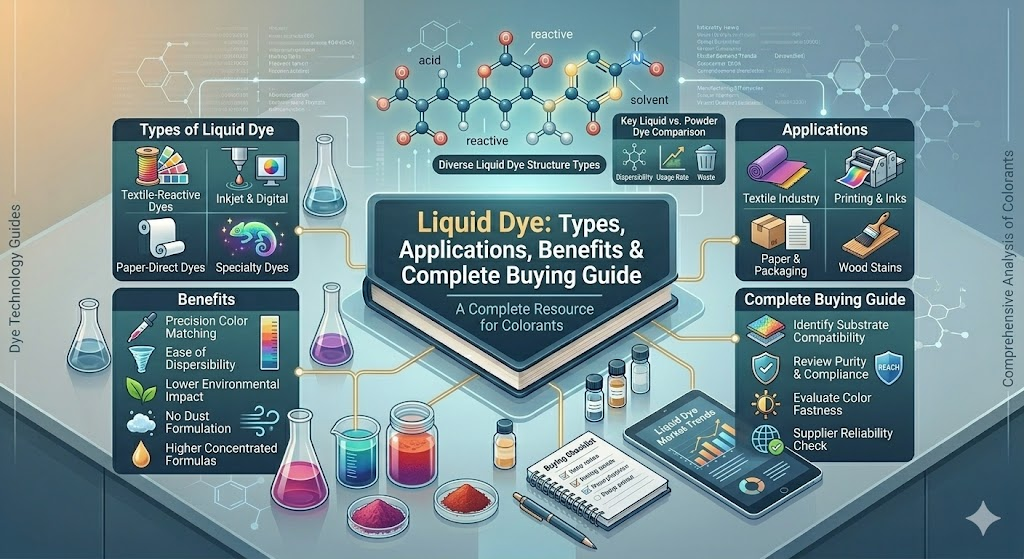
If you work in fuel blending, textile processing, ink manufacturing, or any industry that requires reliable, consistent colour, chances are you have already made the switch from powder dyes to Liquid Dye. And if you have not, this guide might convince you. Over the past few decades, liquid dyes have steadily replaced their powdered predecessors across most industrial applications — and for very good reasons.
In this article, we will walk you through what Liquid Dye actually is, the different types available, where it is used, why it outperforms powder dye in most settings, and what to look for when sourcing it. Whether you are a procurement manager, a formulation chemist, or simply exploring colourant options for a new project, this guide is designed to give you the practical knowledge you need.
What Is Liquid Dye?
A Liquid Dye is a colourant that has been pre-dissolved or dispersed in a liquid carrier — either a solvent (such as xylene, toluene, or high-flash hydrocarbons) or water. Unlike powder dyes that require manual weighing, grinding, and dissolution before use, liquid dyes arrive ready to use: measure the required volume, add it to your process, and the colour is instantly and uniformly distributed.
This seemingly simple difference — liquid versus powder — has enormous practical implications for safety, consistency, efficiency, and cost. We will get into those in detail below.
Types of Liquid Dyes
Not all liquid dyes are the same. The type you need depends entirely on what you are colouring and the medium it needs to dissolve in. Here is a breakdown:
| Type of Liquid Dye | Carrier Medium | Key Applications | Example Dyes |
| Solvent-Based Liquid Dyes | Hydrocarbon solvents (xylene, HF, toluene) | Fuels, lubricants, waxes, candles, oil-based inks | Solvent Red 164, Solvent Yellow 107, Solvent Blue 79 |
| Water-Based Liquid Dyes | Water | Textiles, paper, food, cosmetics, cleaning products | Acid dyes, direct dyes, food-grade dyes |
| Reactive Liquid Dyes | Water (alkaline bath) | Cotton, cellulose, viscose fibres | Reactive Red, Reactive Blue, Reactive Yellow |
| Acid Liquid Dyes | Water (acidic bath) | Wool, silk, nylon, leather | Acid Black, Acid Blue, Acid Red |
| Metal-Complex Liquid Dyes | Alcohols, glycol ethers, organic solvents | Wood stains, printing inks, leather finishes, coatings | Solvent Black 27, Solvent Yellow 21 |
For petroleum and industrial applications, solvent-based liquid dyes are the most widely used category. For textiles, water-based reactive and acid dyes dominate. The key is matching the dye’s solubility to the medium you are colouring.
Key Applications of Liquid Dye Across Industries
Petroleum and Fuel Colouring
This is one of the largest single markets for liquid dyes. Refineries worldwide use solvent-based liquid dyes to colour-code fuels for tax identification, grade differentiation, and anti-adulteration purposes. The transition from powder dyes to liquid dyes in this sector began in the 1960s and is now virtually complete — driven by the safety, consistency, and handling advantages of liquid formulations.
Textiles and Garments
Water-based liquid dyes (reactive, acid, and direct dyes in liquid form) are used by textile mills for dyeing cotton, wool, silk, nylon, and blended fabrics. Liquid formulations offer faster dye-bath preparation, more uniform colour uptake, and reduced waste compared to powder dosing.
Inks and Coatings
Both solvent-based and water-based liquid dyes are used in printing inks for packaging, markers, ballpoint pens, and industrial coding. Metal-complex liquid dyes are widely used in wood stains, leather finishes, and transparent coatings.
Plastics and Polymers
Liquid solvent dyes are used to colour thermoplastics such as polystyrene, acrylic, PET, nylon, and polycarbonate during the moulding or extrusion process. The dye dissolves into the polymer melt, producing transparent, vivid colouring.
Wax, Candles, and Speciality Products
Liquid dyes dissolve cleanly in paraffin, soy wax, and gel wax, making them the preferred choice for candle manufacturers who need consistent colour without sediment or wick-clogging issues.
Advantages of Liquid Dye over Powder Dye
The shift from powder to liquid has been one of the most significant practical improvements in the dye industry. Here is a side-by-side comparison:
| Factor | Liquid Dye | Powder Dye |
| Handling Safety | No airborne dust; lower inhalation and skin contact risk | Generates fine particles; requires dust masks, extraction systems |
| Ease of Use | Ready to use; measure and pour/inject | Requires weighing, grinding, pre-dissolution |
| Dosing Accuracy | Volumetric dosing via pumps; highly precise | Manual weighing; more prone to variation |
| Dissolution Speed | Instant — already in solution | May take 30–60+ minutes to fully dissolve |
| Colour Consistency | Batch-to-batch uniformity is inherently high | Depends on dissolution technique and completeness |
| Storage | Sealed containers; minimal spillage risk | Bags/drums; dust contamination risk on opening |
| Integration with Automation | Easily integrated into automated injection systems | Difficult to automate |
| Shelf Life | Typically 1–2 years | Longer (dry powder is inherently stable) |
| Cost per Active Dye | Slightly higher (includes solvent) | Lower per kg (but higher total processing cost) |
The bottom line: for most industrial applications, the total cost of ownership for Liquid Dye is lower than powder, once you factor in labour, safety equipment, waste, and consistency improvements.
Factors to Consider Before Buying Liquid Dye
Compatibility: Ensure the dye’s carrier solvent is compatible with your application. Solvent-based dyes for fuels; water-based dyes for textiles. Mismatching will cause poor dissolution or phase separation.
Concentration and dye content: Liquid dyes are sold at varying active dye concentrations. A higher-concentration product may cost more per litre but delivers more colour per unit volume, reducing shipping and storage costs.
Regulatory compliance: For fuel dyes, ensure the product meets local government marking regulations. For textiles, check compliance with REACH, Oeko-Tex, or other safety standards applicable to your market.
Batch consistency: Ask for certificates of analysis (CoA) confirming colour strength and dye content for each production batch. Consistency is critical for downstream quality.
ISO certification: Look for manufacturers holding ISO 9001:2015, ISO 14001:2015, and ISO 45001:2018 as evidence of quality, environmental, and safety management.
Custom blending capability: Many applications require specific shades. A capable manufacturer will offer custom colour matching and bespoke blends.
Storage and Handling Tips for Liquid Dye
Proper storage extends shelf life and maintains colour quality. Keep liquid dyes in tightly sealed, original containers, stored in a cool, dry area between 5°C and 40°C. Avoid direct sunlight and proximity to heat sources. For solvent-based liquid dyes, ensure the storage area meets flammable-liquid ventilation and fire-safety requirements. Always wear appropriate PPE (gloves, eye protection, lab coat) when handling, and consult the manufacturer’s SDS for product-specific guidelines.
Case Study: How a Textile Mill Cut Dyeing Time by 40% After Switching to Liquid Dye
Background: A mid-size textile mill in Surat, Gujarat, processing approximately 15,000 metres of cotton fabric per day, was using powder reactive dyes for its continuous dyeing line. The dye-kitchen operation involved manual weighing of powder dyes, pre-dissolution in hot water, filtration to remove undissolved particles, and transfer to the dye-bath tank — a process that took 45–60 minutes per batch.
The Problem: The powder dissolution step was the bottleneck of the entire dyeing line. Incomplete dissolution was causing specking (tiny undissolved dye particles on fabric), leading to a 6–8% rejection rate on first-quality inspection. Additionally, powder handling was creating persistent dust contamination in the dye kitchen, raising occupational health concerns and requiring expensive extraction equipment.
The Solution: The mill transitioned to pre-dissolved liquid reactive dyes supplied by an ISO-certified manufacturer. The liquid dyes were delivered in sealed drums at standardised concentrations, allowing direct volumetric dosing into the dye-bath via a metering pump — eliminating the weighing, dissolution, and filtration steps entirely.
Results:
| Metric | Before (Powder Reactive Dyes) | After (Liquid Reactive Dyes) |
| Dye-Bath Preparation Time | 45–60 minutes per batch | 5–10 minutes per batch |
| Fabric Rejection Rate (Specking) | 6–8% | <1% |
| Daily Production Throughput | ~15,000 metres | ~21,000 metres (+40%) |
| Dye-Kitchen Dust Complaints | Frequent; extraction system required | Eliminated |
| Dosing Accuracy | Manual — ±10% variation | Metering pump — ±2% variation |
| Annual Dye Wastage | ~12% (spills, undissolved residue) | ~3% |
Key Takeaway: The switch to Liquid Dye did not just improve one metric — it transformed the entire operation. The elimination of the powder dissolution bottleneck unlocked a 40% increase in daily throughput, while the reduction in fabric rejections and dye wastage delivered significant cost savings that more than offset the slightly higher per-litre cost of the liquid dye.
Choosing a Trusted Liquid Dye Manufacturer
When sourcing Liquid Dye for industrial use, the manufacturer’s track record matters as much as the product itself. Look for a supplier with deep domain expertise, proven batch consistency, ISO certification, and the flexibility to offer custom formulations.
Anar Chemicals LLP is an established liquid dye manufacturer based in India with over four decades of experience in dyes and speciality chemicals. They are ISO 9001:2015, ISO 14001:2015 & ISO 45001:2018 certified and produce a comprehensive range of liquid solvent dyes for petroleum products, candle dyes, and smoke dyes. Their Liquid Petroleum or Fuel Dyes range includes reds, yellows, blues, greens, oranges, and custom blends — all available in multiple solvent bases. Explore their full Products catalogue or contact them directly for enquiries.
Frequently Asked Questions About Liquid Dye
Q: What is Liquid Dye used for?
Liquid Dye is used across multiple industries for colouring fuels, lubricants, textiles, plastics, inks, paper, wax, candles, leather, and cosmetics. Liquid dyes offer faster dissolution, more uniform colour distribution, and easier handling compared to powder dyes.
Q: Is Liquid Dye better than powder dye?
For most industrial applications, yes. Liquid Dye eliminates dust hazards, requires no pre-dissolution, provides more consistent colour, and integrates easily into automated dosing systems. Powder dyes may still be preferred for certain speciality chemistry applications where ultra-high purity is needed.
Q: What are the main types of liquid dyes?
The main types include solvent-based liquid dyes (for fuels, oils, plastics), water-based liquid dyes (for textiles, paper, food, cosmetics), reactive liquid dyes (for cotton and cellulose fibres), acid liquid dyes (for wool, silk, nylon), and metal-complex liquid dyes (for inks, coatings, wood stains).
Q: How should liquid dyes be stored?
Store liquid dyes in tightly sealed, light-resistant containers in a cool, dry area between 5°C and 40°C. Avoid direct sunlight, extreme heat, and contact with oxidising agents. Under proper conditions, most liquid dyes have a shelf life of 1–2 years.
Q: Where can I buy Liquid Dye in India?
Anar Chemicals LLP (anarchem.com) is an ISO-certified liquid dye manufacturer based in India with over 40 years of experience. They produce petroleum liquid dyes, candle dyes, and smoke dyes, and supply to clients globally. Other options include IndiaMart and TradeIndia directories.
Q: Can liquid dyes be custom-blended?
Yes. Experienced manufacturers like Anar Chemicals offer custom shade matching and bespoke dye blends to meet specific colour requirements. This is common in petroleum fuel colouring, where country-specific regulations may require unique shades.
Q: Are liquid dyes safe to handle?
Liquid dyes are generally safer to handle than powder dyes because they eliminate airborne dust particles. However, standard chemical safety precautions still apply: use gloves, eye protection, and adequate ventilation. Always consult the manufacturer’s Safety Data Sheet (SDS).