If you work in petroleum dye manufacturing, speciality chemical synthesis, or industrial surfactant production, you have almost certainly come across Para Dodecyl Aniline — even if you know it better as PDA, 4-dodecylaniline, or simply “dodecyl aniline.” It is one of those essential building-block chemicals that rarely gets the spotlight, but without it, an entire category of high-performance petroleum dyes and industrial surfactants simply would not exist.
In this guide, we will break down exactly what Para Dodecyl Aniline is, why its unique molecular structure matters, where it is used across industries, and what to look for when sourcing it. Whether you are a dye chemist formulating petroleum colourants, a procurement specialist evaluating intermediate suppliers, or a researcher exploring alkylated aniline derivatives, this article is for you.
What Exactly Is Para Dodecyl Aniline?
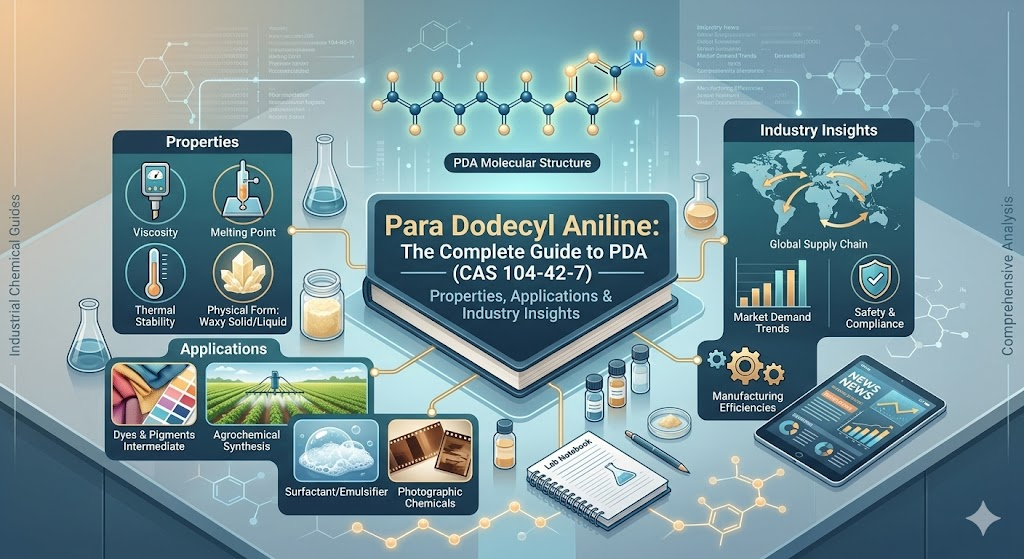
Para Dodecyl Aniline (CAS No. 104-42-7) is an organic compound with the molecular formula C₁₈H₃₁N and a molecular weight of 261.45 g/mol. Structurally, it is an aniline molecule — a benzene ring with an amino (-NH₂) group — where a 12-carbon (dodecyl) straight-chain alkyl group has been substituted at the para position (the 4th carbon of the ring).
This dual nature is what makes Para Dodecyl Aniline so industrially valuable. The aniline “head” is reactive — it can undergo diazotisation, coupling reactions, and other classic aromatic amine chemistry. Meanwhile, the long dodecyl “tail” is hydrophobic, imparting excellent oil solubility and surfactant-like properties to any molecule that incorporates it. In chemical terms, PDA is an amphiphilic molecule: one end is polar, the other is non-polar.
This amphiphilic architecture is precisely why Para Dodecyl Aniline is the intermediate of choice for manufacturing modern liquid petroleum solvent dyes. When PDA is used as a coupling component in azo dye synthesis, the resulting dye inherits the long alkyl chain — giving it dramatically higher solubility in fuels, oils, and organic solvents compared to dyes made from unsubstituted aniline.
Key Chemical Properties of Para Dodecyl Aniline (CAS 104-42-7)
Here is a quick-reference summary of PDA’s essential chemical and physical properties:
| Property | Details |
| Chemical Name | 4-Dodecylaniline (Para Dodecyl Aniline) |
| CAS Number | 104-42-7 |
| Molecular Formula | C₁₈H₃₁N |
| Molecular Weight | 261.45 g/mol |
| EC Number | 203-201-3 |
| Chemical Class | Alkylated aromatic amine |
| Appearance | White to off-white waxy solid or low-melting solid |
| Boiling Point | 220–221°C at 15 mmHg |
| Solubility | Insoluble in water; soluble in ethanol, toluene, xylene, hydrocarbons |
| Purity (Industrial Grade) | ≥97% |
| Key Functional Groups | Primary amine (-NH₂), dodecyl alkyl chain (-C₁₂H₂₅) |
| Reactivity | Readily diazotised; undergoes coupling, acylation, and alkylation |
The combination of reactive amine functionality with a long hydrophobic chain is what makes Para Dodecyl Aniline uniquely suited for applications where both chemical reactivity and oil solubility are required in the end product.
Primary Applications of Para Dodecyl Aniline
1. Petroleum Solvent Dye Manufacturing (The Core Application)
This is where Para Dodecyl Aniline has its biggest industrial impact. Modern petroleum dyes — the liquid solvent dyes used to colour fuels, lubricants, and oils worldwide — are predominantly azo dyes synthesised by diazotising an aromatic amine and coupling it with a naphthol or phenol. When Para Dodecyl Aniline is used as the amine component, the resulting dye carries the long C12 alkyl chain, which gives it exceptional solubility in hydrocarbon solvents.
This is the fundamental reason why today’s liquid petroleum dyes (such as Solvent Red 164, Solvent Yellow 107, and various custom fuel dye blends) can be supplied as concentrated liquid solutions rather than dry powders. The alkyl chain contributed by PDA eliminates the crystallisation and low-solubility problems that plagued earlier-generation petroleum dyes.
2. Surfactant Synthesis
The amphiphilic structure of Para Dodecyl Aniline makes it a valuable starting material for synthesising speciality surfactants. These include sodium 4-dodecylphenylazosulfonate and other anionic or non-ionic surfactants used in industrial cleaning, emulsification, and oilfield chemistry.
3. Corrosion Inhibitor Intermediates
Long-chain alkylated anilines, including PDA, are used in the formulation of corrosion inhibitors for the oil and gas industry. The amine group adsorbs onto metal surfaces, forming a protective film, while the long alkyl chain provides a hydrophobic barrier against corrosive media.
4. Research and Materials Science
In academic and industrial R&D, Para Dodecyl Aniline is used as a building block for liquid crystals, conductive polymers, functionalised nanotubes, and other advanced materials where a long-chain aromatic amine is required.
Application Overview Table
| Application Sector | Specific Use | Role of PDA |
| Petroleum Dye Manufacturing | Azo dye synthesis for fuel/oil colouring | Coupling component; alkyl chain provides fuel solubility |
| Surfactant Production | Sodium 4-dodecylphenylazosulfonate, etc. | Amphiphilic precursor for surface-active agents |
| Corrosion Inhibitors | Metal protection in oilfield and industrial systems | Amine adsorbs to metal; alkyl chain forms hydrophobic barrier |
| Materials Science / R&D | Liquid crystals, conductive polymers, nanotube functionalisation | Long-chain aromatic amine building block |
| Speciality Chemical Synthesis | Custom intermediates, agrochemicals, pharma precursors | Versatile alkylated aniline for diverse chemistry |
Para Dodecyl Aniline vs. Other Alkylated Anilines
PDA is not the only alkylated aniline used in industry. Here is how it compares with related compounds:
| Parameter | Para Dodecyl Aniline (PDA) | Aniline (Unsubstituted) | 4-Nonylphenol | Para Phenylenediamine (PPD) |
| CAS Number | 104-42-7 | 62-53-3 | 104-40-5 | 106-50-3 |
| Molecular Formula | C₁₈H₃₁N | C₆H₇N | C₁₅H₂₄O | C₆H₈N₂ |
| Alkyl Chain | C12 (dodecyl) | None | C9 (nonyl) | None |
| Oil Solubility | Excellent | Poor | Excellent | Poor |
| Primary Industrial Use | Dye intermediate, surfactants | Polyurethane, dyes, rubber | Surfactants, antioxidants | Hair dye, rubber antioxidant |
| Role in Dye Chemistry | Coupling component for oil-soluble azo dyes | Diazotisation base for water-soluble dyes | Coupling component | Oxidation dye base |
The key differentiator for Para Dodecyl Aniline is its C12 chain length — long enough to ensure excellent hydrocarbon solubility in the end product, yet short enough to maintain good chemical reactivity at the amine group. This balance is what makes PDA the preferred intermediate for petroleum-grade dye synthesis.
Case Study: Improving Fuel Dye Solubility by Switching to a PDA-Based Dye Intermediate
Background: A mid-size liquid petroleum dye manufacturer in South Asia was experiencing persistent solubility issues with their red fuel dye product. Their existing formulation used a shorter-chain alkylated aniline as the coupling intermediate, which resulted in dyes that would occasionally crystallise out of solution during cold-weather storage (≤ 5°C) and leave deposits in customers’ dosing equipment.
The Problem: Three key customers — all fuel depot operators — reported dye precipitation during winter months, leading to clogged injection lines and inconsistent fuel colouring. The manufacturer risked losing these contracts if they could not deliver a cold-stable product.
The Solution: The R&D team reformulated their red azo dye using Para Dodecyl Aniline (CAS 104-42-7) as the coupling intermediate instead of the shorter-chain variant. The longer C12 alkyl chain from PDA produced a dye with significantly higher solubility in the high-flash solvent base, even at low temperatures.
Results:
| Metric | Before (Short-Chain Intermediate) | After (PDA-Based Intermediate) |
| Cold-Weather Stability (5°C) | Crystallisation after 2–3 weeks | Clear and stable for 6+ months |
| Maximum Solids in Xylene | ~35% | >55% |
| Customer Complaints (Quarterly) | 5–7 | 0 |
| Dye Injection Clogging Incidents | 8 per winter season | 0 |
| Raw Material Cost Impact | Baseline | ~6% increase (offset by fewer returns) |
| Customer Retention | At risk (3 accounts) | All 3 accounts retained and expanded |
Key Takeaway: The slightly higher cost of Para Dodecyl Aniline as a raw material was more than offset by the elimination of product returns, customer complaints, and reputational risk. This case demonstrates why PDA has become the industry-standard intermediate for modern petroleum dye manufacturing.
What to Look for When Sourcing Para Dodecyl Aniline
Not all PDA is equal. Since the product is synthesised via Friedel-Crafts alkylation of aniline with dodecene, the quality of the final product depends heavily on reaction selectivity and purification. Here is what matters:
Purity (≥97%): Lower-purity PDA contains isomeric by-products and unreacted starting materials that can reduce the performance of downstream dyes and intermediates. Insist on batch-specific certificates of analysis.
Para-selectivity: The dodecyl group must be predominantly in the para position for optimal dye synthesis. Ortho-substituted by-products can cause undesirable colour shifts or reduced solubility.
Consistent colour and form: High-quality PDA should be a white to off-white solid. Significant discolouration (brown or dark yellow) may indicate oxidation or impurities.
Reliable supply chain: PDA is used in continuous production processes. Inconsistent supply or variable quality can disrupt manufacturing schedules downstream.
ISO certification: Manufacturers holding ISO 9001:2015, ISO 14001:2015, and ISO 45001:2018 certifications demonstrate commitment to quality, environmental responsibility, and safety.
Anar Chemicals LLP is an established manufacturer of dyes, intermediates, and speciality chemicals with over four decades of experience. They are ISO 9001:2015, ISO 14001:2015 & ISO 45001:2018 certified and operate dedicated multipurpose plants for dye intermediates. Explore their Products page or learn more about their Infrastructure to understand their manufacturing capabilities.
Frequently Asked Questions About Para Dodecyl Aniline
Q: What is Para Dodecyl Aniline?
Para Dodecyl Aniline (4-dodecylaniline, CAS 104-42-7) is an organic chemical intermediate consisting of an aniline molecule with a 12-carbon (dodecyl) alkyl chain attached at the para position. It is used as a key building block in the synthesis of petroleum solvent dyes, surfactants, corrosion inhibitors, and speciality chemicals.
Q: What is the CAS number for Para Dodecyl Aniline?
The CAS number for Para Dodecyl Aniline is 104-42-7. It is also known as 4-dodecylaniline, p-dodecylaniline, or PDA.
Q: Why is Para Dodecyl Aniline important for petroleum dye manufacturing?
Para Dodecyl Aniline is used as a coupling component in the synthesis of azo-based petroleum solvent dyes. Its long dodecyl chain dramatically improves the solubility of the resulting dye in fuels, oils, and other hydrocarbon solvents — which is the critical performance requirement for modern liquid petroleum dyes.
Q: What is the molecular formula of Para Dodecyl Aniline?
The molecular formula is C₁₈H₃₁N, with a molecular weight of 261.45 g/mol.
Q: Is Para Dodecyl Aniline soluble in water?
No. Due to its long hydrophobic alkyl chain, Para Dodecyl Aniline is practically insoluble in water. It is, however, soluble in organic solvents such as ethanol, toluene, xylene, and various hydrocarbon solvents.
Q: What purity levels are available for Para Dodecyl Aniline?
Industrial-grade Para Dodecyl Aniline is typically available at 97% purity or higher. For speciality synthesis applications, higher-purity grades may be sourced on request from experienced manufacturers.
Q: Where can I buy high-quality Para Dodecyl Aniline?
Para Dodecyl Aniline is available from speciality chemical manufacturers such as Anar Chemicals LLP (anarchem.com), an ISO 9001:2015, ISO 14001:2015 & ISO 45001:2018 certified company with over 40 years of experience in dyes, intermediates, and speciality chemicals.
Q: How should Para Dodecyl Aniline be handled and stored?
Like most aromatic amines, Para Dodecyl Aniline should be handled with standard chemical safety precautions — protective gloves, eye protection, and adequate ventilation. Store in tightly sealed containers in a cool, dry place away from oxidising agents. Always consult the manufacturer’s SDS for specific guidelines.